
Quick report
- Cracking
- widespread
Storm day - and what a storm.
- High snowfall rates in the morning (S2-5) that tapered off early AM.
- Total snowfall 8-10 inches.
- The storm snow was very sensitive (touchy) to human triggers during the peak snowfall, though the sensitivity diminished as the snow accumulated.
- Gusty, variable winds arrived late morning, with moderate snow transport near ridgelines.
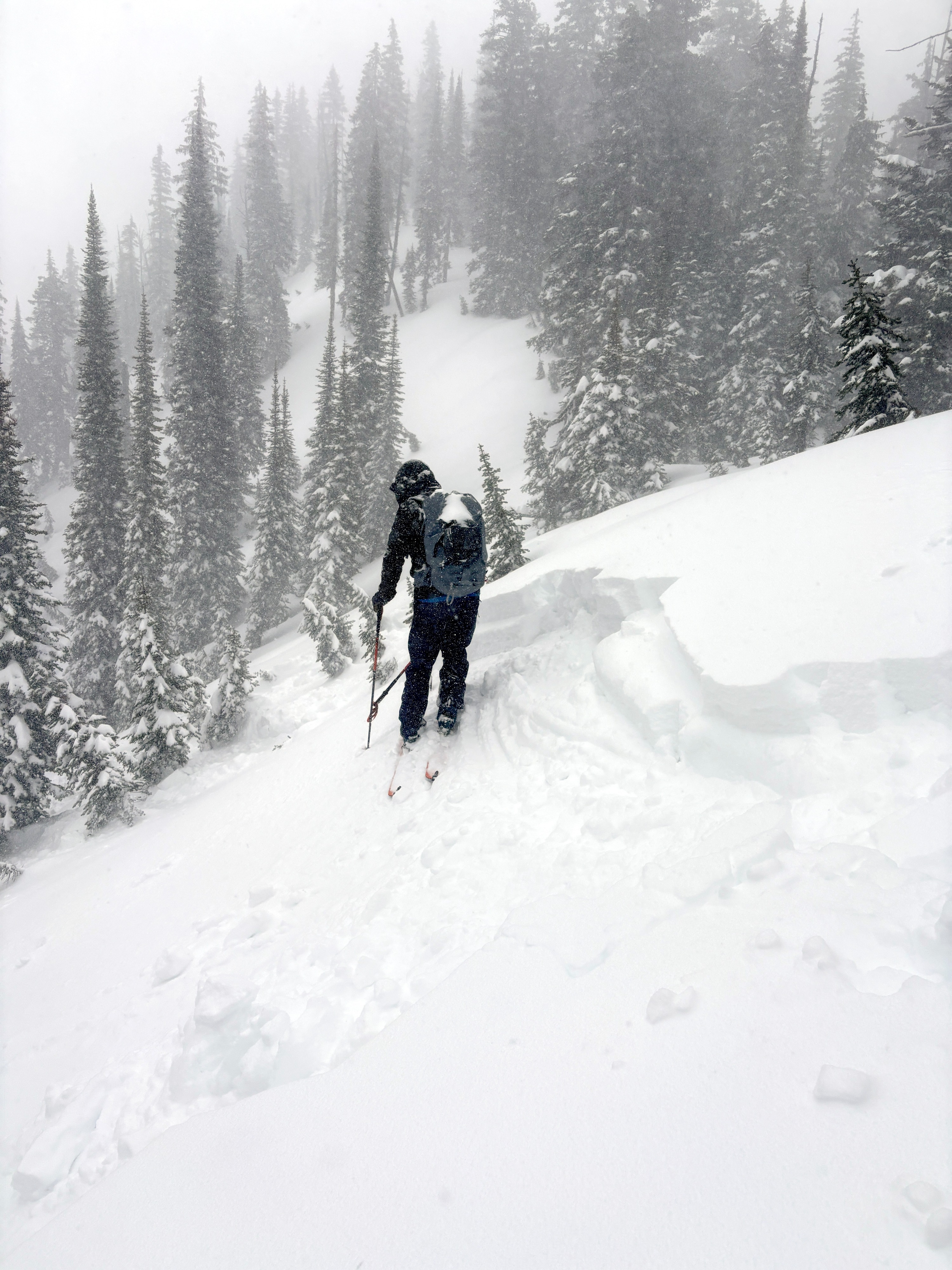
- We triggered one large avalanche remotely from a ridgeline (see avalanches). We were surprised that stomping above nearby slopes did not produce more avalanches, though we didn't expose ourselves to steep start zones.
- The troubling surface hoar/ melt-freeze crust is buried about 75 cm below the surface. It failed with alarming energy in large column tests, though with medium-hard force. That suggests any triggered slides would propagate long distances and very dangerous amounts of debris. It will be more sensitive to human triggers where it is closer to the surface.
We did not expose ourselves to any terrain that could produce more than a D1 avalanche.
Widespread shooting cracks and triggered small, soft slabs during peak snowfall. No whumpfing. By early afternoon, we couldn't get cracking on steep slopes despite (or because of) another 15 cm new snow.Weather
- Air Temp
- Low 20s
- Cloud Cover
- obscured
- Wind Loading
- moderate
- Recent Snowfall
- 20
- Snow Avail For Transport
- moderate amounts
Stormy, with peak snowfall mid-morning (S2-5). Total snowfall 20-25 cm. Gusty and variable winds starting late morning. Often easterly. Snowfall ended early-mid afternoon and skies went broken.
Snowpack
The snow that fell during the peak storm intensity was relatively low density crystals with lots of arms. Once winds picked up, the snow was denser and composed more of needles/ columns.
The soft slab avalanches failed at the old/ new snow interface. I suspect that as that interface was loaded by denser snow, the thin weak layer was compressed/ crushed and sensitivity diminished.
In a profile at 6600 feet on a northwest facing slope, the new snow did not propagate in ECTs (ECTN6x2) and did not produce sudden failures in CTs (CT 6x2 RP). The 2/10 interface - a thin layer of buried surface hoar and facets - also did not propagate in ECTs (ECTN 16x2).
The buried surface hoar/ melt freeze crust structure (clearly visible thanks to lots of debris and the color change) propageted with startling energy (ECTP 18, 22). There's a thin ice lens above this structure that may make it less sensitive to human triggering. However, once collapsed - boom.
Avalanche
- Size
- D1 R2
- Type
- SS
- Count
- 4
- Aspect
- E
- Trigger
- N
- Elevation
- 4800 ft
Numerous soft slabs from natural or remote triggers. Most failed mid-morning, during peak snowfall. By early afternoon, slabs were stubborn on steep test slopes rather than touchy.