
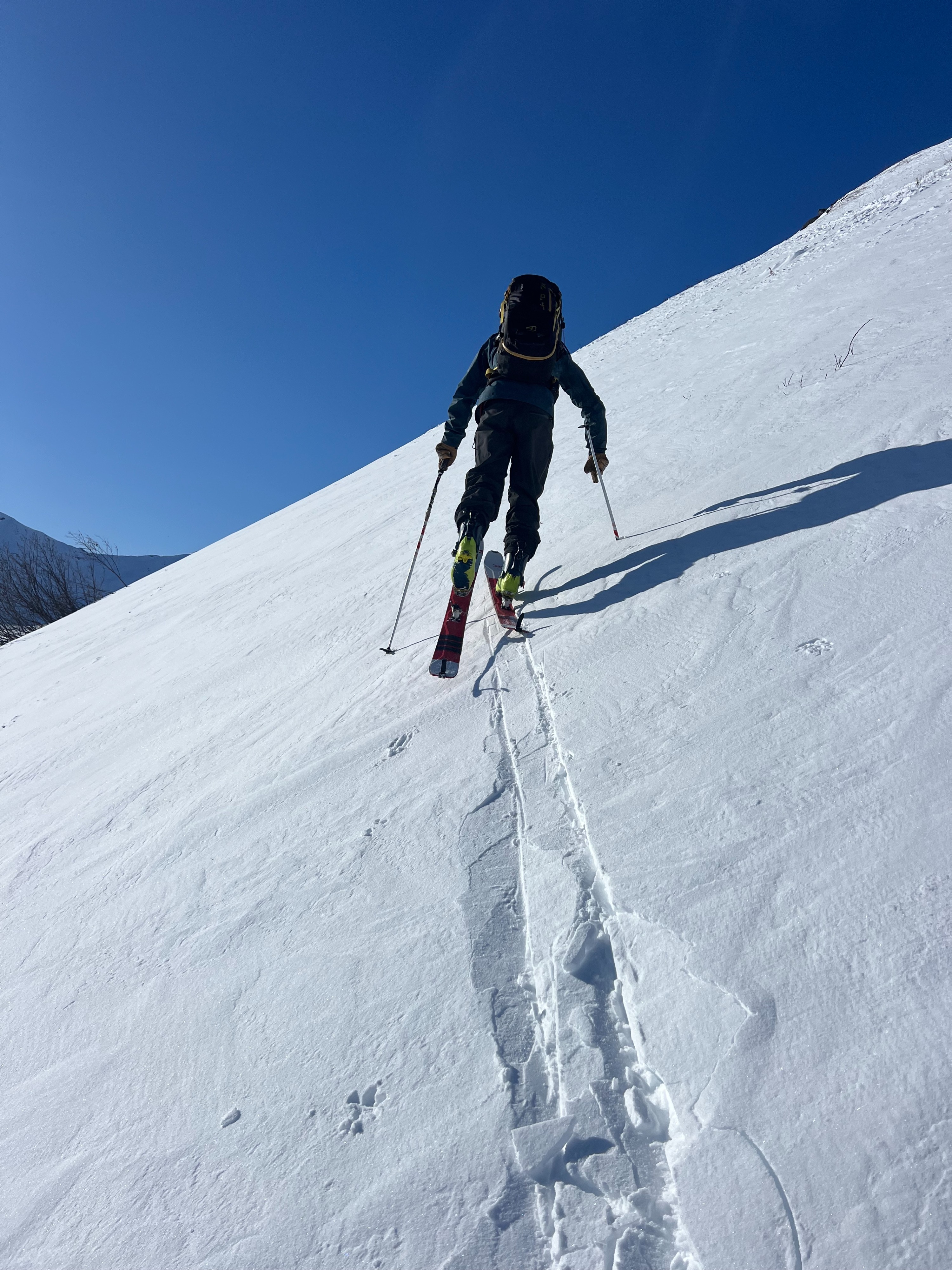
Quick report
Observed conditions were stable, and we are in another day of status quo with our weather and snowpack. We observed some bulletproof strength in the upper snowpack, even in shallow areas where the height of snow was 85cm or less.
While we are still able to get propagation in snowpit stability tests, we have not seen a human-triggered avalanche in our most recent post-loading event (since 2/15). We have not observed a persistent slab avalanche failing on weak snow near the ground since 1/31. See all recent observations here.
Still, these layers in the upper, midpack remain worth tracking, and although unlikely, it would not be impossible to find a small pocket of old wind slab on more protected, leeward slopes in steep and extreme terrain. These slabs are also unlikely to translate to large, cross-slope connectivity, though know that the place you could still trigger an avalanche would be in these areas.
No instabilities observed--cracking, collapsing or whumphing. It remains possible to get propagation in snowpits (see snowpack), although these results are not translating to the slope-scale stability we are seeing, even in shallower terrain.Weather
- Air Temp
- -4
- Cloud Cover
- clear
- Wind Loading
- previous
- Rain Elevation
- N/O
- Recent Snowfall
- NO
- Snow Avail For Transport
- none
Cold, calm and clear. We experienced a light, northerly breeze that felt pretty arctic towards the end of the day as temperatures dropped from single to double digits below 0. Things felt warm in the sun. With February skies and sub zero temperatures, solar input did nothing to the upper snowpack though felt nice on our faces, fingers and toes.
Snowpack
Snow surfaces were extremely variable from soft and gently wind drifted at valley level and bulletproof, knife hard and un-edgeable. We found reasonable riding conditions on our ESE aspect descent where surfaces were ever so slightly faceted, though
Snowpit tests at 3,800' on ESE revealed a few different layers of interest worth tracking for when/if we ever get a substantial load. We got everything from ECTP1 to ECTP18 on a few different layers/interfaces, the most reactive of which was the shallow (3-5") wind slab over small .25-.5mm faceted grains and other, buried wind slabs. Midpack at this location had a buried P hard crust ~45 to 65cm↑ in 65-85cm of snow. We got repeatable propagation from the elbow (ECTP16, ECTP18) on this layer. We found loose, unconsolidated basal facets and depth hoar at the bottom 20cm of the snowpack. We found some propagation (ECTP22) on these basal layers 15 to 20cm↑.
Despite the propagating snowpit results in snowpits, knife to pencil hard wind slab caused us to experience a stable, albeit upside-down, snowpack in the area we toured.