
Quick report
- Cracking
- specific
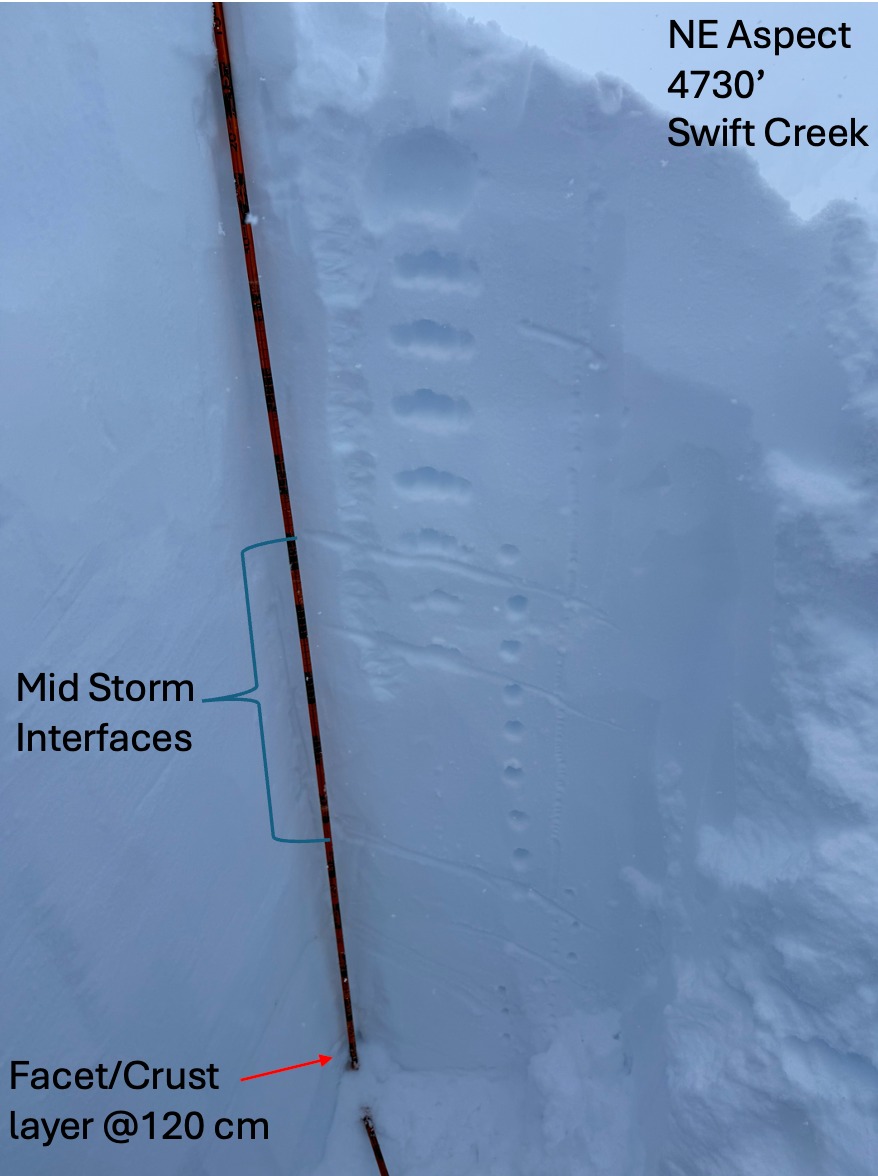
We experienced sustained easterly winds throughout the day, with strong gusts moving tree tops and actively transporting snow, often swirling around micro-terrain features. Temperatures increased steadily, and light snow transitioned to warmer, sleet-like precipitation by the late afternoon. The snow surface was a mix of wind-loaded layers, hollow snow, and an unusual melt-freeze crust that appeared sporadically. Below the surface, the snowpack was generally right side up down to a facet-crust combo layer buried about 120 cm deep. While stability tests showed limited reactivity, the presence of a planar weak layer at this interface warrants continued monitoring. * I apologize for not having more photos Cracking around skis. Some hand shears released with easy force.
Weather
- Cloud Cover
- overcast
- Wind Loading
- moderate
- Snow Avail For Transport
- moderate amounts
Snowpack
Given the uninspiring skiing conditions, we decided to shift our focus to snowpack assessment and spent the day practicing snow pits. We dug four pits on a small knoll at the top of Swift Creek, spanning E, NE, N, and NW aspects. Our goal was to investigate any aspect-dependent patterns in the snowpack, with a particular focus on the facet-crust layers buried deeper down. The crust layer we were targeting sat approximately 120 to 130 cm below a right-side-up storm slab. On the E, NE, and N aspects, our stability tests produced no significant results; however, in shovel shear tests, the blocks failed on a planar surface with moderate force. On the NW aspect, we were able to initiate failure in compression tests (CTH RP x2), though the layer was stubborn to react. At the failure interface, we observed small, 1 mm rounding facets.