
Quick report
After multiple human-triggered avalanches on Saturday, we toured into Commonwealth to get a better sense of the problem and assess for a potential weak layer/weak interface (1/10). We had to balance our desire to get more information on the snowpack with the need to minimize our exposure to the avalanche hazard. To manage the hazard, we made a tour plan that closed the steep and open slopes in the upper reaches of Kendall and planed for our high point to be at about 5200'. We targeted the 1/10 interface, which in that location, was below about 6" of storm snow. We didn't get any propagating results in extended column tests, but hand shears and compression tests yielded easy results. The day left us with a good bit of uncertainty about the nature of the problem on wind-loaded slopes, as we were unable to assess for instabilities in locations with deeper wind-drifted slabs. The combination of recent activity, reported whumpfs from Saturday, and the poor bond at the interface kept us out, and will continue to keep us out of steeper terrain until we can gain more certainty around the problem.
Below about 4500', travel conditions are horrid. The trail was slick and bullet proof, and anywhere off trail is covered in frozen tree bomb debris.
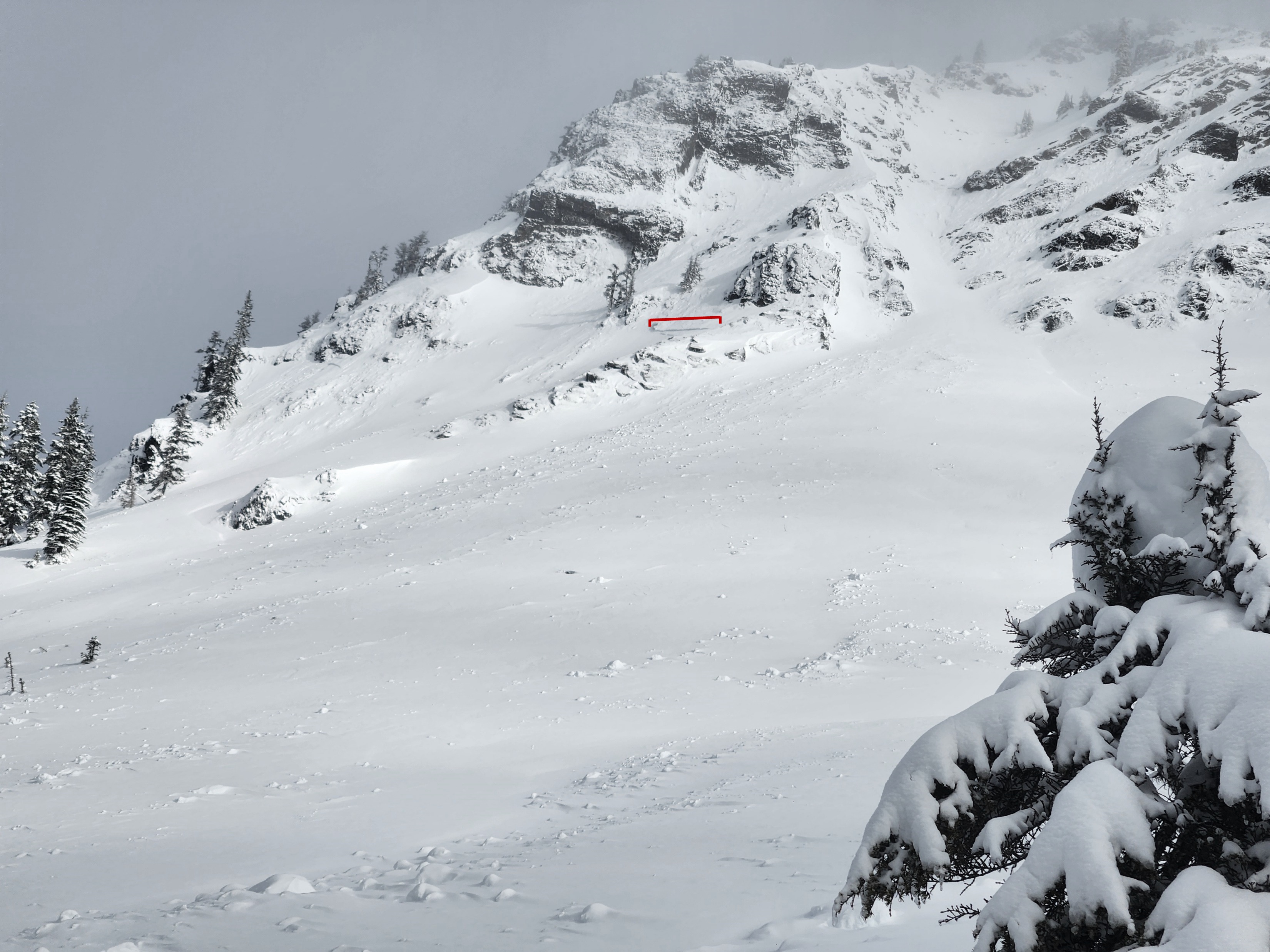
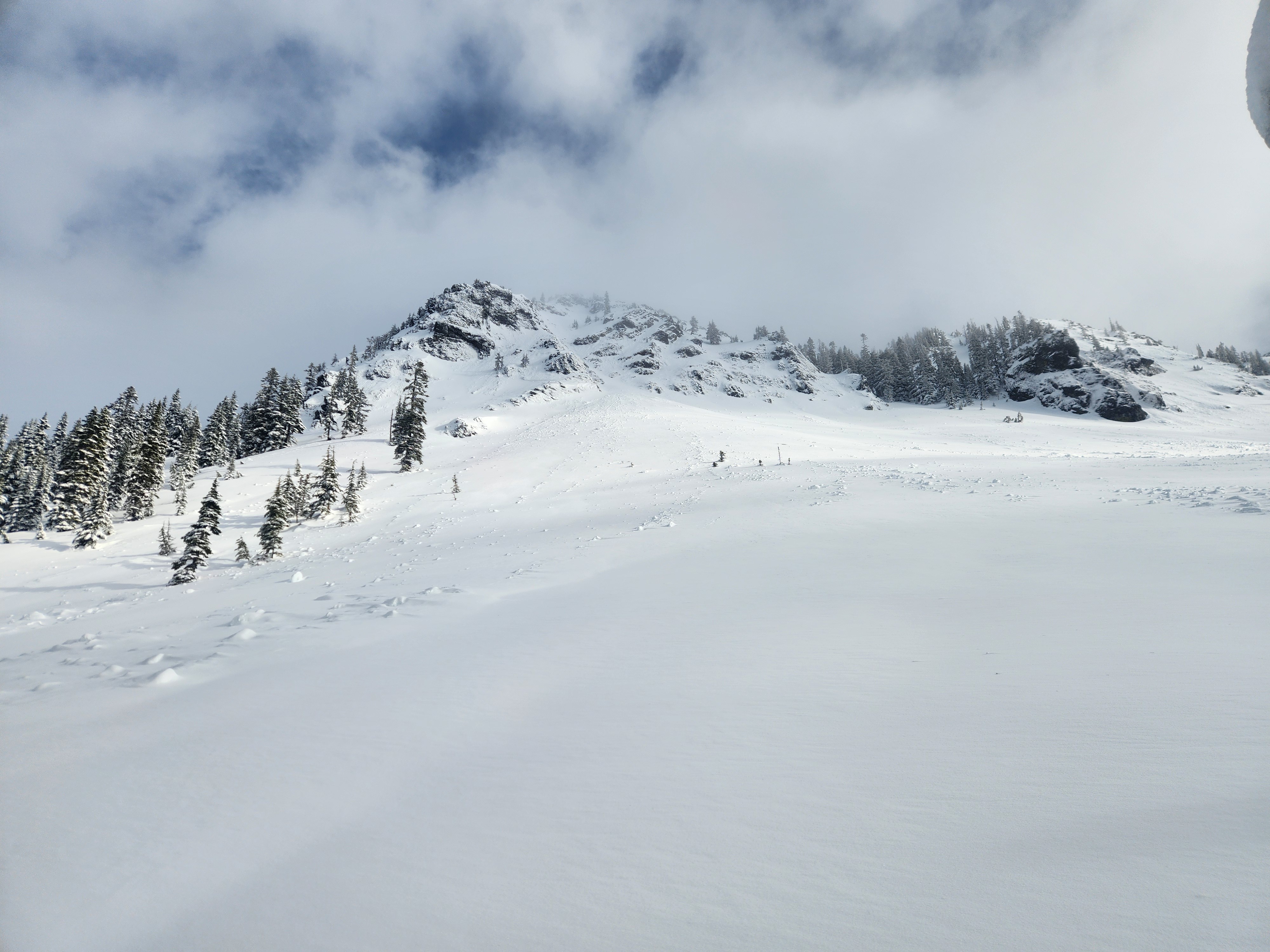
Debris on the southwest face of Kendall - much of it may have been older from the cycle last weekend, but some was fresh. We observed two recent crowns, one in a more sheltered spot on a convexity and the other on a very wind-exposed slope (image of crown in observation).Weather
- Cloud Cover
- broken
- Wind Loading
- previous
- Rain Elevation
- 4000-4500
- Recent Snowfall
- 14
- Snow Avail For Transport
- moderate amounts
It was a gorgeous day in the mountains. Calm winds, good visibility, and plenty of sun breaks in through the early afternoon. Skies cleared further and became partly cloudy around 1:30 pm. No blowing snow or active loading was observed.
Snowpack
Below about 4500' we encountered a surface crust, often supportable, sometimes breakable. Above that point, the storm snow got deeper and lower (though never low) in density as we ascended to our high point at 5200'. At that high point, in a sheltered location, we found 6" of right side up storm snow sitting on the 1/10 crust. Hand pits sheared easily on some low density decomposing fragments (some with rime) right on top of the crust. There may have been a stray angular grain or three mixed in, but the majority of grains were DF's or precipitation particles, with some rime.
We dug our first pit on a SW aspect at 4900'. The location was wind-exposed, but not wind-loaded.
CT 16 - Q1, ECTN19 down 13 cm on/just above crust.
We dug two pits on a WSW aspect at 5200' in a sheltered area.
CT 3 - Q1 x2, ECTN Medium x2 down 14 cm on a few mm of decomposing fragments above 1/10 crust.
Below the 1/10, the snow is dense, quite homogenous, and right side up from 1F to P+. Our concerns were limited to the 1/10 and above.