
Quick report
This was an off-duty evening bop to move the legs, look at the snow, and get a little pow in my face.
I did not experience any cracking or collapsing. I did not observe any recent avalanches, aside from the small dry loose sluffs that I was able to initiate terrain steeper than 40 degrees.Weather
- Cloud Cover
- overcast
wx obs from 1800-2100: 4-5cm new snow at highway level, 8-10cm by 7500, 12-15cm (?)at 9,000, hard to tell given amount of wind transport. Winds were intermittently gusting into moderate speeds out of the SW. Warm and mild, but all precip fell as snow. Only the HN is available to wind transport unless wind direction switches, which may happen Tuesday. This could put a lot more snow into play
Snowpack
I dug in the same location I dug one week previous. We have added about an inch of water in the time since, and there has been significant consolidation of the upper snowpack.
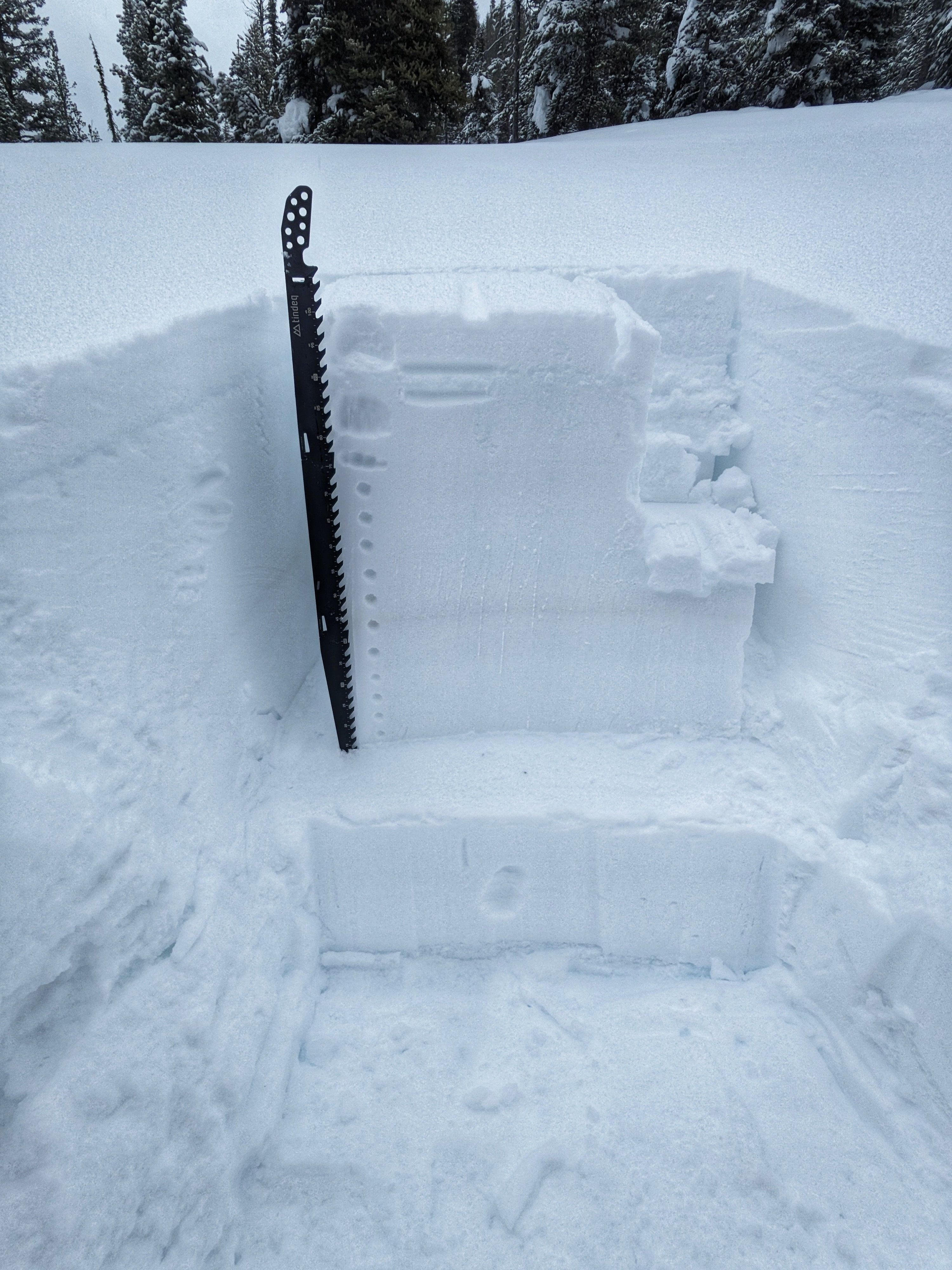
Snowpit on W aspect at 7,400':
HS=230-240cm
3/10 layer buried down 8-10cm under the new snow, kind of an unremarkable crust, maybe with some small facets underneath? Hard to say how this will behave without getting a better slab on it.
2/29 Leap Day dust interval down 55cm. This is a great indicator layer in the snowpack! Its easy to get lost in the upper pack in our northern mountains where much more snow has fallen, this helps. Originally there was a prominent graupel layer here, but graupel grains were no longer visible. There was thunder snow observed at Williams Yurt when this was being deposited, awesome!
2/24 layer buried down 85-90cm, this is my persistent layer of concern and continues to drive terrain selection. This presented as a 2cm thick crust with small but well-developed facets on top.
In this pit location, I received ECTNs on subtle, not particularly concerning layers in the upper 30-40cm of the snowpack. I was able to get fractures to initiate and propagate cleanly and crisply across my column on the 2/24 MFcr+FC, but this required additional force outside the bounds of the standard ECT (an extra 15 and 20 hits from the shoulder). When watching deeper layers like this, I'm more focused on how they behave than if they are failing within standard loading steps. In areas where this layer is closer to the surface and more accessible (wind-swept, peppery, alpine) I think that initiating a collapse that propagates into a starting zone remains within the realm of possibility.
3/10 thoughts: The surface that we just buried is variable. During the early stages of formation (3/6-3/8) we had some great weak layer building conditions. Crusts were thin, breakable, and accompanied by well-developed facets above and below (lots of RadRx - radiation recrystallization). We also deposited several rounds of SH on these nights. Inversions were deep for these nights, and low elevation snow surfaces underwent some aggressive faceting below the level of the inversion. Winds picked up 3/9 and 3/10 and temperatures warmed, we did a lot of wind-cleaning of crust+facet combos (particularly on S-SW-W), which likely muted these surfaces. Warm temps likely muted surfaces on shadies at least at lower and the lower end of middle. I'm still pretty suspicious of this layer and expect that we will see some wide crowns from wind slabs with the ongoing storm and the potential for this to be a longer-lived weak layer in specific terrain (where associated with crusts in particular).
Avalanche
Visibility was poor, thanks to low light and ongoing snowfall. I did not observe any avalanches aside from the small dry loose sluffs that I was able to initiate terrain steeper than 40 degrees.