
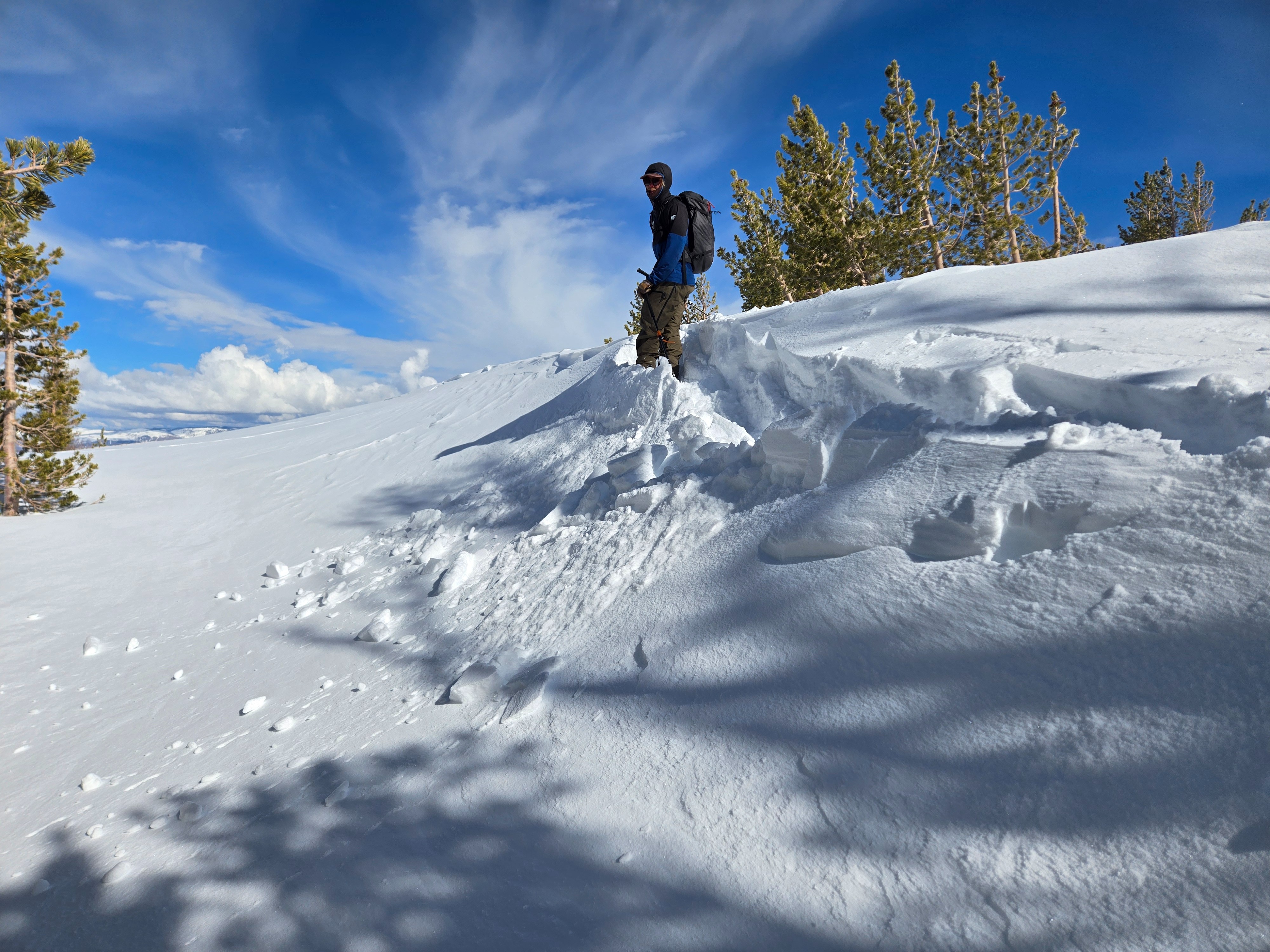
Quick report
We adopted a "stepping back" mindset today. We travelled on solar aspects and low slope angles to reach northerly slopes where we could look at the persistent slab problem up close, but without getting burned. Along the way we noted about a foot of dry snow on souterly slopes that could warm in full sun, and we noted that wind slabs were becoming stubborn.
See snowpack section for details on the persistent slab observations we made.
We did not get any direct feedback from the persistent slab problem on the carefully chosen terrain we travelled on. We could only get recently formed wind slabs to crack when we had undercut them with the skin track.Weather
- Air Temp
- 30s at lower elevations, teens at 10,000 ft.
- Cloud Cover
- few
- Wind Loading
- light
- Rain Elevation
- NO
- Recent Snowfall
- 40
- Snow Avail For Transport
- moderate amounts
Beautiful day. Cold air temps with windchill at ridge top. Light northwest wind, light blowing snow.
Snowpack
We tested the facet layer buried 2/10 on two separate pieces of terrain. Both were near treeline at 10,100 ft. and both faced due north.
- Propagating test results indicating the potential for human-triggered avalanches (ECTP13) on a leeward slope where the winds on 2/11 drifted a stiffer slab (4F) directly atop a soft (F hard) layer of fragmented grains and near-surface facets.
- No results (ECTX) on a wind-sheltered slope where the recent new snow sat directly atop large weak facets. However, in this location, nothing had stiffened the recent snow into a slab (F to 4F-).
We got to these locations by travelling up solar slopes, both to look at how much dry snow could transition to wet on a fully sunny, warm day, and to avoid having to manage the uncertainty over the persistent slab problem.
- Steep, south-facing gullies below treeline had up to 35 cm of low-density, dry snow sitting atop a melt-freeze crust.
Avalanche
Avalanches are recorded in a separate driving observation.