
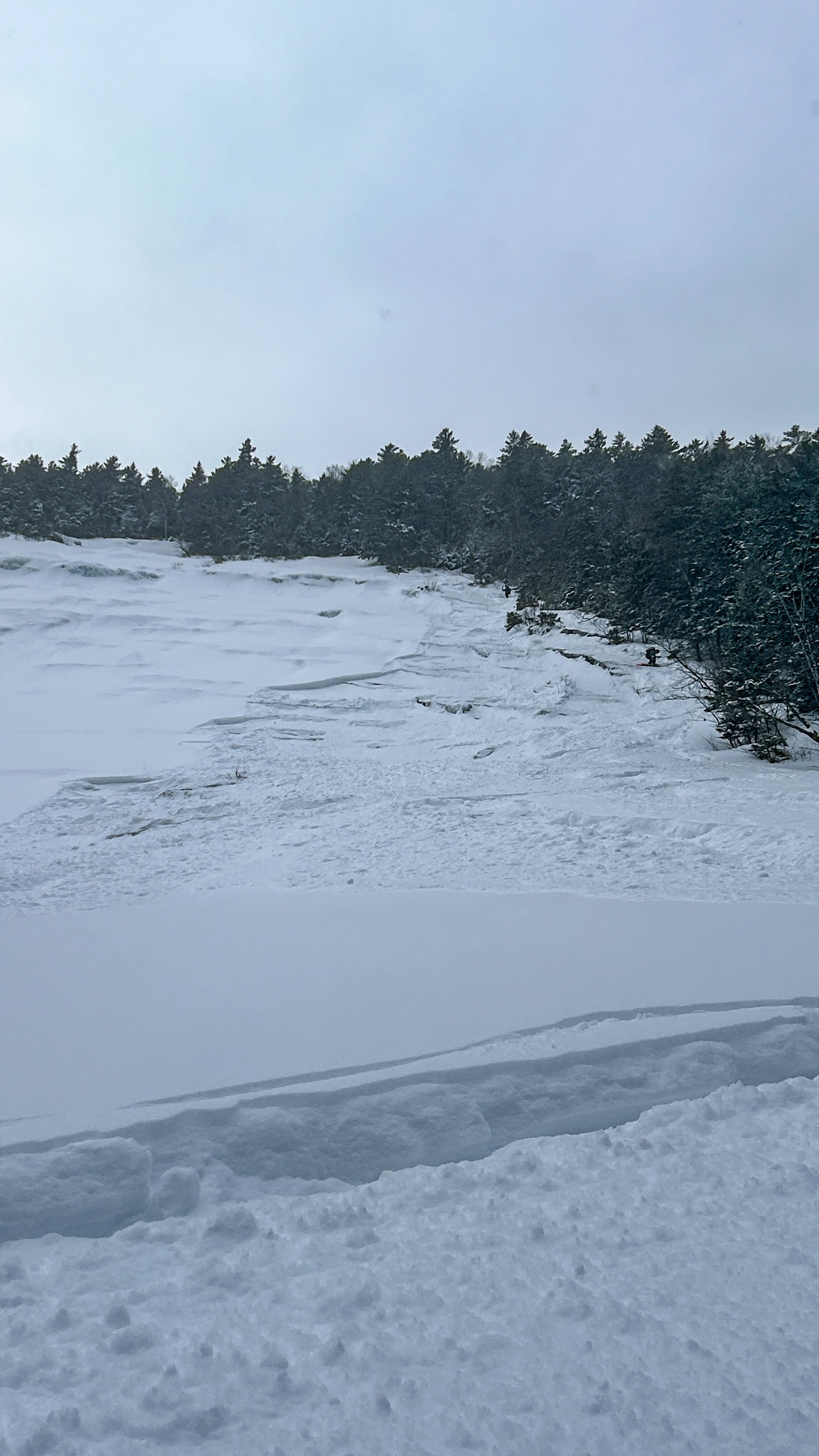
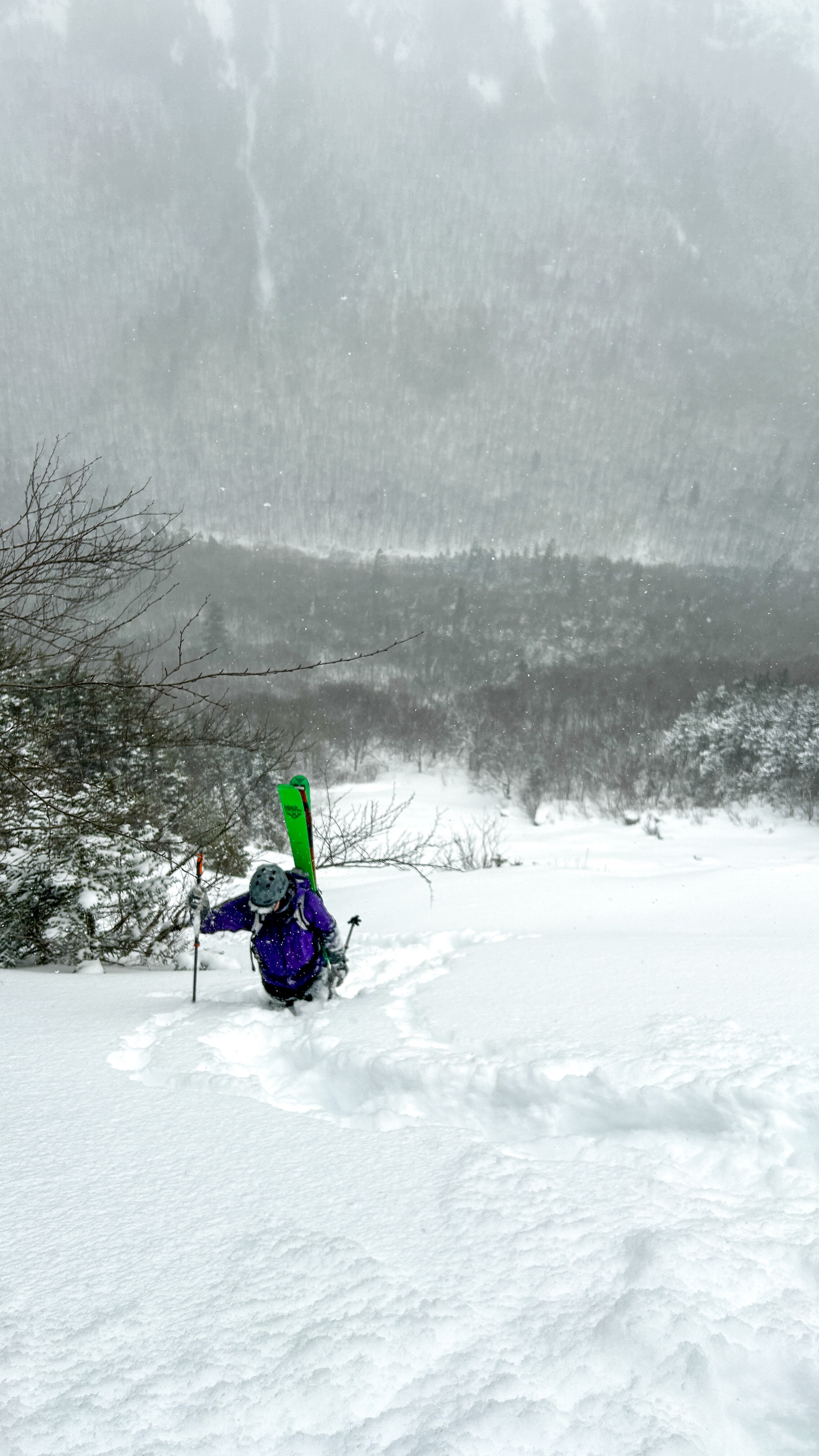
Quick report
Generally stable snowpack conditions were observed throughout the day. It snowed longer than expected with minimal wind both in the woods and on the more open face of Willey's Slide. The mindset of "easing into terrain" while gaining a better understanding of the recent snowfall/snowpack was followed throughout the day. Slope angle and poor bonding between old ice and recent snow were the primary environmental factors leading to the avalanche. More detailed observations and reflections are provided in the "avalanche summary."
Avalanche
- Size
- D2
- Aspect
- NE
- Trigger
- AS
- Elevation
- 2093 ft
Group: The group consisted of five experienced backcountry skiers, three of whom are avalanche professionals working as instructors and guides. Plans & Events: The day began at the Willey’s TH and after catching up, conducting transceiver checks, and reviewing plans/goals, a skin track was established up to the first line of the day. The initial group of three departed unaware that the group of two was behind them. However, shortly after beginning their ascent, the group of two caught up to the initial party of three. Individuals in both groups knew/know each other quite well and possess a great deal of respect for each others’ skills, knowledge, and experience(s). Once the party of five was established we ascended a narrow creek bed (wallowing at times in waist to chest deep snow) until the group collectively decided to turn around when the line ended in steep rock and ice. Until this point the most obvious signs of instability were a few isolated dry loose releases that quickly came to rest in undulating and discontinuous terrain features. The snowpack would generally be described as “right side up” with micro spatially variable exceptions. One member of the party hypothesized water from the creek beds played a role in adding moisture to the snowpack subsequently altering its structure. While this certainly isn’t responsible for the eventual avalanche, it’s nonetheless worthy of further inquiry and provided fodder for a thoughtful discussion about the snowpack. Skier one descended the top of the first line cautiously due to dense vegetation, and then enjoyed deep and stable turns once the line opened up. Skier one waited in a safe spot (e.g. not directly below the fall line) at the bottom of the first pitch for the remainder of the group to descend. Unfortunately, the final skier lost their ski and required assistance finding it. A member of the original group of three had a time constraint so it was decided the original group of three would descend and the party of two would continue looking for the ski. Radio communication was established and maintained throughout the day which provided effective dialogue between group members. The party of three descended and began skiing back to Willey’s. One group member decided to ski all the way to the road due to aforementioned time constraints. The other two members chose to skin up to investigate and attempt to ski Willey’s and Little Willey’s slides. While putting skins back on, the group of two that had been looking for the lost ski radioed to let us know they had found it. I (Blake) radioed back and informed them of our plan and that we would begin putting in a skin track and boot pack for them. Once the skin track cleared the woods, it was quickly obvious that putting skis on our packs and booting would be the more efficient means of travel. During this transition, the first two skiers discussed means of ascent, descent, and perhaps most importantly, collectively agreeing we didn’t want to ski above the more consequential terrain traps in the middle of the line. Booting was relatively fast and efficient and the first party of two was roughly halfway up the line when the second group returned. The second group radioed to inquire if “sharps are needed” and it was relayed to them that there were two short icy spots but they would otherwise enjoy relatively simple and continuous climbing. The first two climbers continued moving uphill until they reached the top of their line. After a quick discussion, the two individuals decided that it was getting late in the day and it would be best to call the current position their high point. While transitioning for the descent, the first two skiers discussed the uneven distribution of new snow throughout the line and subsequently decided that, unlike the rest of the day’s skiing, it would be best to ski this line (specifically the first section) in short pitches. Once gear was double checked for “ski/fun mode,” the party of two waited for the second group to continue climbing. I (Blake) mentioned that I “didn’t want to drop something on top of them, especially since they’re in the choke” so I unbuckled my boots and told the two below us that we would wait for them. The climbers quickly made it through the pinch point and into a more open pocket on skiers left / climbers right. I (Blake) buckled my boots again but told my partner “I just want to wait for them to get to the top of that pocket in case something peels and I need to bail into it… I don’t want to hit them.” The avalanche released on my second turn and was relatively small to begin with. I was easily able to move into the aforementioned pocket and watched as an initially small dry loose avalanche gained momentum and volume as it went over numerous bands of rock and ice, eventually coming to rest near the bottom of the line. Upon initial reflection, the “crux” of the day was the point where we could have begun descending above the party climbing up to us. Had that happened it’s likely someone would have been caught, carried, and potentially injured given the obvious terrain traps. Thus, while we probably didn’t need to sharp end test what we already knew and discussed at the beginning of the day (the new snow wouldn’t bond well to steep ice), applying a “premortem” decision-making process to determine the precise timing and means of skiing likely prevented a far worse outcome. Conversely (note: only speaking for myself) the above events can largely be attributed to an internal “substitution error:” my brain bounced back and forth between “can I ski this?” vs. “should I ski this?” I remember being excited about the possibility of creatively connecting the dots in good snow on an ephemeral line that’s often difficult to ski from the top. Learning is a nonlinear and iterative process that on this particular day unfolded in the presence of good friends, trusted partners, and via open dialogue(s). Moving ahead, I look forward to continuing to refine my ability to reflect on, and better understand, internal and external environments.