
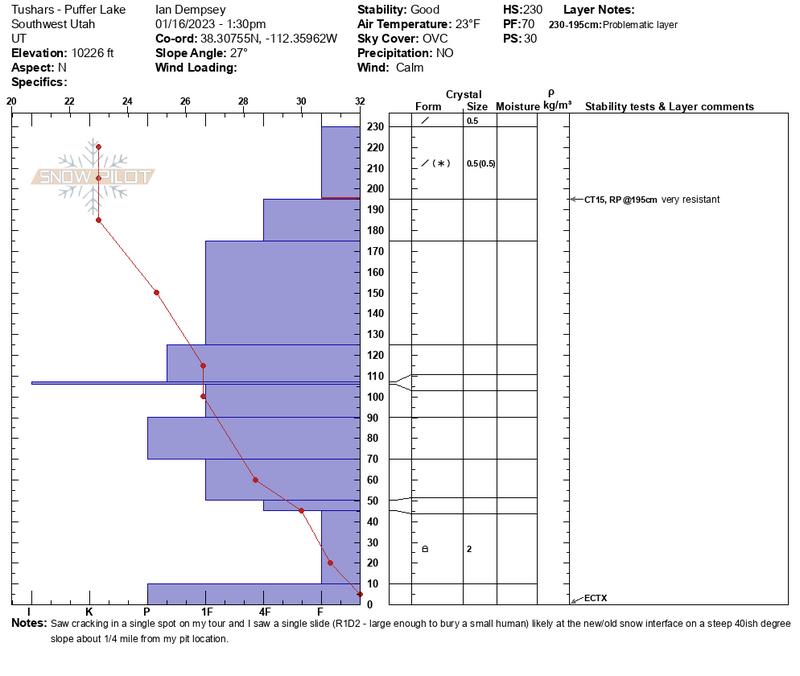
Quick report
- Aspect
- North
- Red Flags
- Heavy Snowfall, Poor Snowpack Structure
- Elevation
- 3109 m
- Slope Angle
- 27°
- Red Flags Comment
- <p>I saw cracking in a single spot and I saw a single slide (R1D2 - large enough to bury a small human) likely at the new/old snow interface on a steep 40ish degree north facing slope about 1/4 mile from my pit location. It appeared to have occurred naturally, perhaps last night or yesterday as it was covered in fresh snow.</p>
Snowpack
- Instability Comment
- <p>The 35 cm of storm snow seems to be bonding well to the old snow surface. My CT on a 27 degree slope did get a resistant planar (RP) fracture at 15 taps and when I tried to pull it off the column it broke apart. As noted above I also observed a small R1D2 slide relatively close to my pit location in what appeared to be the new/old snow interface. It was snowing heavily by the time I made it back to my car, and the temperature appeared to be dropping, so hopefully any new accumulation will be lower density. The new/old snow interface is something to watch as more snow accumulates, especially if there is a turn towards higher density snowfall in the new accumulation.</p> <p>It's hard to even call this a problem, but to be on the conservative side, it is worth noting that the snowpack does have a poor structure. It is very deeply buried the layer is 10-50 cm above the ground in a 230 cm snowpack - almost a full two meters beneath the surface). If this were to fail it would be massive. I did not test this layer in my CT or ECT as I would probably need to use a different snow stability test to try to get any results. The layer consists of 2mm rounding facets fist hard on the hand hardness scale. As UAC forecasters have noted this layer is healing slowly and could be triggered in a thin spot in the snowpack, but it is gaining stability as the snow keeps piling up.</p> <p> </p> <p>Another interesting finding was that there was a pretty stout ice crust at 107 cm above the ground.</p>