

Bollettino valanghe

Sawtooth & Western Smoky Mtns

Sawtooth Avalanche Center
Vedi sulla mappa

Pericolo valanghe

Fri
Alta quota
2 · Moderato
Limite del bosco
2 · Moderato
Sotto il limite
1 · Debole
Non aggiornato — questo bollettino è scaduto 4 years ago. Stai vedendo condizioni passate, non il bollettino in corso.

In sintesi

You may be able to trigger avalanches in both sheltered and wind-affected terrain. In areas protected from the wind, 1.5-2 foot thick avalanches are possible on shady slopes. In more exposed locations, you could trigger hard or soft drifts or slabs that formed over the past several days. Loose snow avalanches are likely as the sun peels snow from warm, rocky, extreme terrain. Even small slides can have big consequences on slopes with cliffs, trees, and terrain traps.

Problemi valanghivi

  • Persistent Slabs

    • Alta quota
    • Limite del bosco
    • Sotto il limite del bosco
    Probabilità
    Possible
    Dimensione
    1.5–2

    In the past two weeks, skiers and riders triggered several avalanches involving a layer of surface hoar buried 1.5-2 feet deep. A skier triggered a slide on this layer Sunday in the Salmon River drainage (view report). The surface hoar "problem" remains capable of producing avalanches on some slopes steeper than about 35 degrees. 

    Buried surface hoar is challenging to deal with. Its patchy distribution means you may find it on one slope but not the next, and it can be hard to identify when searching for it in a snowpit (see photo to right/above). It's often best preserved and more sensitive in small clearings and open, wind-protected terrain on shadier aspects. 

    You can reduce your risk by avoiding slopes facing NW-N-NE that are steeper than about 35 degrees. Consider the consequences of going for a ride. Even small slides can have bad outcomes if they lead to trees, cliffs, or a creek bed. 

    ADDITIONAL DISCUSSION: Older weak layers (often facets found near crusts, with some surface hoar) exist deeper in the snowpack. These layers are buried beneath dense, 3-4+ thick slabs. While triggering them is unlikely, it can't be ruled out in steep, rocky, wind-affected terrain. 

    A skier triggered this 1-2 foot thick avalanche on Sunday Jan 29th on a N-NE aspect at 9100' near Titus Ridge. It failed on a layer of buried surface hoar.

  • Wind Slabs

    • Alta quota
    • Limite del bosco
    • Sotto il limite del bosco
    Probabilità
    Possible
    Dimensione
    1–1.5

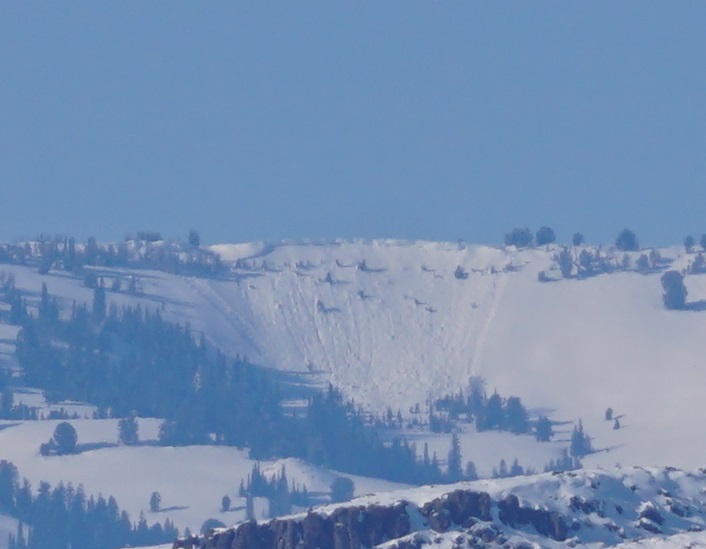
    Last weekend's snow and northerly wind formed soft 1-2' thick slabs in exposed terrain. A handful of small natural wind slab avalanches occurred over the weekend (Galena Pass, Banner). Monday, we spotted a large wind slab in the Soldier Mtns (photo). 

    This problem is most dangerous at upper elevations where slabs are larger and more widespread. Look for them near ridgelines, on the sides of gullies and chutes, and near prominent terrain features. In the steep, rocky terrain of the Sawtooths, you'll also find slabs where snow has cascaded down and accumulated below cliffs (example).

    Cracks shooting out from your skis or sled are an obvious sign of instability (example). Watch for drifts, dunes, and ripples on the snow surface. Older hard slabs can have a smooth, chalky appearance and feel and sound hollow, like a drum. Wind-deposited snow will be stiffer and keep your skis or snowmobile closer to the surface.

    (1/29/2023) This small wind slab released naturally on Titus Ridge near Galena Summit. It failed on a E/NE-facing slope at 9,600'.

Avalanche Discussion

Here's a quick top-down overview of the snowpack and associated avalanche concerns:

Near the Surface

  • Loose Snow Avalanches: Today's warm temperatures and direct sun may peel soft snow from wind-sheltered, rocky, extreme terrain. Although mostly small, some of these slides will collect enough snow to sweep you off your feet or bury you in a depression. Keep this problem in mind if you're traveling on or beneath large, rocky slopes this afternoon. 

Upper Snowpack

  • Wind Slabs: A few generations of wind slabs formed in the past week. The most recently formed slabs are softer and may be more reactive to your weight. However, the large, recent slide in the Soldier Mtns probably involved rock-hard snow that drifted onto the slope last week; triggering beasts like that is not entirely out of the question. Triggered wind slabs can be effective triggers for deeper weak layers in the snowpack.
  • The persistent weak layer (facets or surface hoar) buried in early January lies beneath a 1.5-2 foot thick slab; impacting it remains a very real possibility. This layer is ugliest on wind-protected, shaded slopes (those on the northern half of the compass) where surface hoar formed. However, a pattern of unstable snowpack test scores on sunnier slopes—where facets and surface hoar lie above a crust—is worth noting. Triggering an avalanche on this weak layer is possible in both sheltered and wind-affected terrain.

Middle and Lower Snowpack

  • Snow depths in most of this zone exceed 6 feet. Weak layers that were buried in November and December lie beneath very dense, heavy slabs of snow. Impacting these weak layers is unlikely but not impossible.

The consequences of triggering avalanches can vary significantly. Triggering a small slide in terrain free of rocks, trees, and terrain traps is much less dangerous than triggering a slide in extreme, rocky, treed terrain with a terrain trap at the bottom. Think about the consequences of being caught in a slide before committing to skiing or riding in sizeable avalanche paths. 

Regioni coperte