

Bollettino valanghe

Northwest Mountains

Crested Butte Avalanche Center
Vedi sulla mappa

Pericolo valanghe

Sun
Alta quota
2 · Moderato
Limite del bosco
2 · Moderato
Sotto il limite
2 · Moderato
Non aggiornato — questo bollettino è scaduto 4 years ago. Stai vedendo condizioni passate, non il bollettino in corso.

In sintesi

Explosive and human-triggered avalanches yesterday offer strong evidence that you can trigger a dangerous avalanche on drifted terrain today.  Sensitive slabs of recently drifted snow exist on leeward features at all elevations and overlap with larger but more difficult-to-trigger slabs that could fail at the ground.  Avoid steep slopes that look or feel recently wind-loaded. 

Problemi valanghivi

  • Persistent Slabs

    • Alta quota
    • Limite del bosco
    • Sotto il limite del bosco
    Probabilità
    Possible
    Dimensione
    1.5–3

    Slabs up to several feet thick have the potential to fail on faceted weak layers near the ground and in the middle of the snowpack. Problematic weak layers exist on most aspects.  The slabs are more common and most sensitive on leeward terrain.    Persistent slabs are notorious for erratic feedback and unusual behavior, such as remote triggering and wide propagation. To reliably avoid the problem, choose routes that keep you off and out from under terrain steeper than about 30 degrees where you find stiff and cohesive slabs. In steeper terrain, you can reduce your chance of triggering an avalanche by avoiding smooth, drifted slopes and trigger points where the snowpack is thinner than average.  

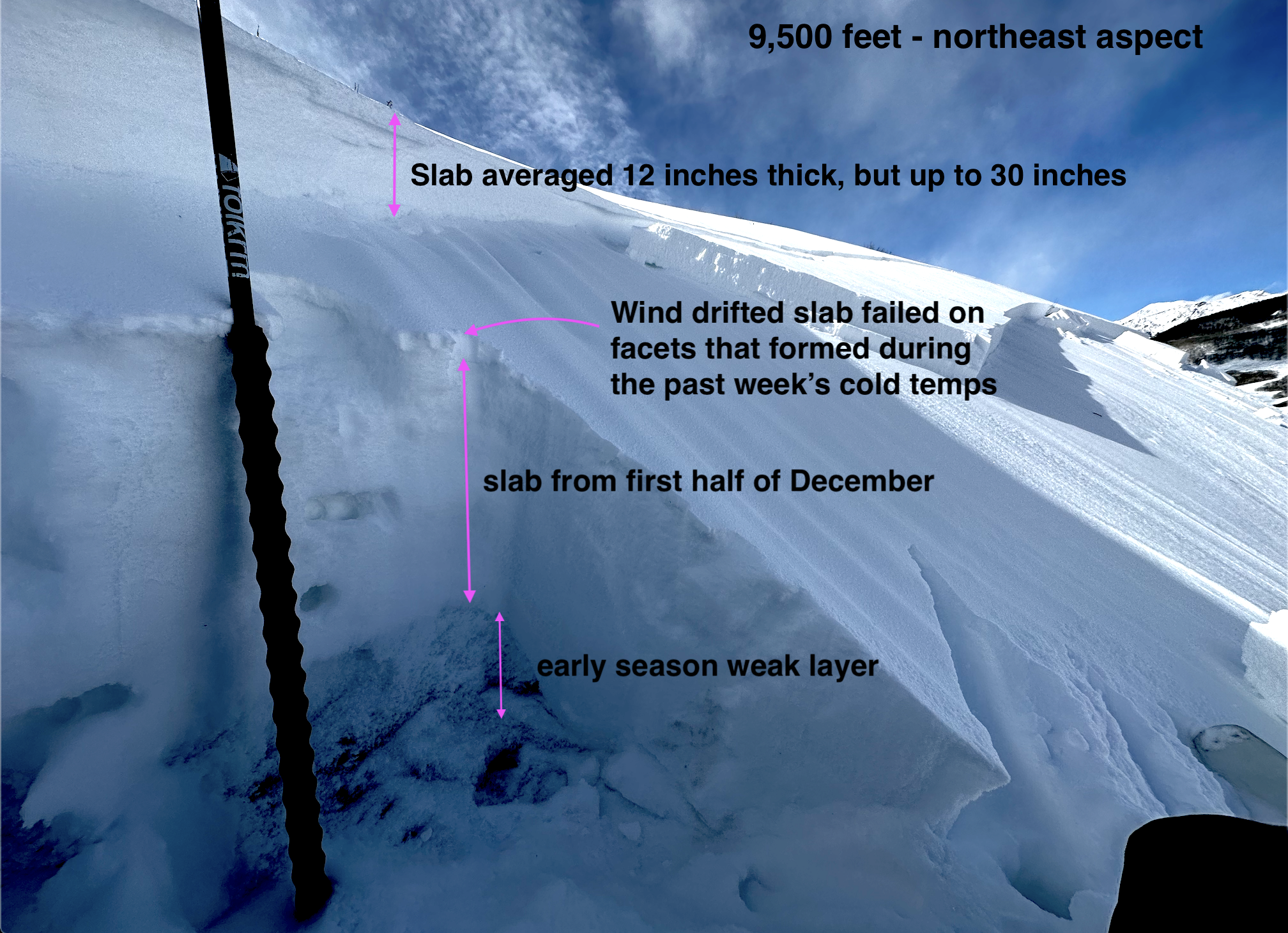
    This persistent slab avalanche wrapped from shady to sunny aspects and broke on weak layers near the ground. This a good example of the potential size and widely propagating behavior of persistent slabs breaking on weak layers near the ground.
Avalanche Discussion

We've made a few noteworthy adjustments to our avalanche problems today.  We're phasing wind slabs off the problem list and shifting lingering wind-drifted instabilities into the persistent slab problem.  Wind slabs are generally healing except where they formed over a layer of facets and faceted crusts that formed during our mid-December dry spell (See this ob of when the layer was just getting buried).  Some of the recent wind slab activity breaking on these layers has already exhibited some of the classic persistent slab behavior such as remote triggering (Irwin, Snodgrass).  This skier-triggered avalanche yesterday on a south-facing slope and continued explosive results at Irwin likely broke on the same problematic layer.  Yup, that means our go-to south-facing terrain that was trustworthy for most of the past month is now on the caution list.  And it also means that we have two weak layers to manage: depth hoar near the ground on west to north to southeast aspects, and a near surface facet layer that's now buried on leeward slopes.  Bummer.  The good news is that issues with both of these layers are most likely to be triggered in recently drifted terrain.  We've seen minor snowfall in the past two weeks, yet our numerous wind events continue to build slabs and add stress to those layers.  Thus, if you have a good eye for those specific loading patterns, you can manage and avoid the most problematic slopes today.  In that same light, we've trimmed higher elevation west and northwest aspects from the persistent slab rose.  Intense wind erosion on Wednesday night scoured slabs from a lot of that terrain.  However, there are always cross-loaded exceptions to be mindful of if you're on that wind-scoured side of the compass.    

The danger has trended down to Moderate because yesterday's visibility and improved weather allowed us to get a better sense of how widespread the recent wind loading is. Check out this video from yesterday.  Natural avalanches are now unlikely, and our observations suggest that today's problems fit a specific distribution pattern.  The majority of avalanches resulting from the Wednesday/Thursday arctic blast broke as wind-drifted slabs at or near the storm interface, D1 to D2. In a few areas where these recent drifts formed over faceted weak layers, those slabs could still be reactive today.   A few avalanches during the arctic blast broke on weak layers near the ground. These thicker slabs are generally stubborn to triggers today but could be up to D3 in size in the deepest parts of the forecast area.  

Regioni coperte