

Bollettino valanghe

Southeast Mountains

Crested Butte Avalanche Center
Vedi sulla mappa

Pericolo valanghe

Wed
Alta quota
2 · Moderato
Limite del bosco
2 · Moderato
Sotto il limite
2 · Moderato
Non aggiornato — questo bollettino è scaduto 5 years ago. Stai vedendo condizioni passate, non il bollettino in corso.

In sintesi

The chance that you could trigger a large slab avalanche has greatly decreased, however, it will not go away. Despite the lack of recent avalanche activity, it is strongly recommended to stay vigilant and continually assess the snow and avalanche terrain for slopes that could still release a large avalanche. The most concerning aspects are on the northern half of the compass. While the safest riding can be found on slopes that previously avalanched earlier this month, and on southerly facing aspects. 

Problemi valanghivi

  • Persistent Slabs

    • Alta quota
    • Limite del bosco
    • Sotto il limite del bosco
    Probabilità
    Possible
    Dimensione
    1–2

    Persistent slabs up to several feet thick are becoming more stubborn to human triggers and they may not alert you to their presence with obvious signs of instability. The problem is on the north half of the compass, where the foundation to our snowpack is weak and faceted. In steep terrain, the distribution of these slabs is variable because of a widespread cycle earlier this month.  Be cautious of steep terrain where you find strong over weak structure, especially in terrain with recent wind loading.  Remember, persistent avalanches can also be remotely triggered from flat terrain below a steep slope, and avalanches might propagate much wider than you expect. Choosing lower slope angles or southerly facing slopes is the easiest and most reliable way to avoid this problem.

    This widely propagating persistent slab ran naturally on December 10th on Mt. Axtell. 
Avalanche Discussion

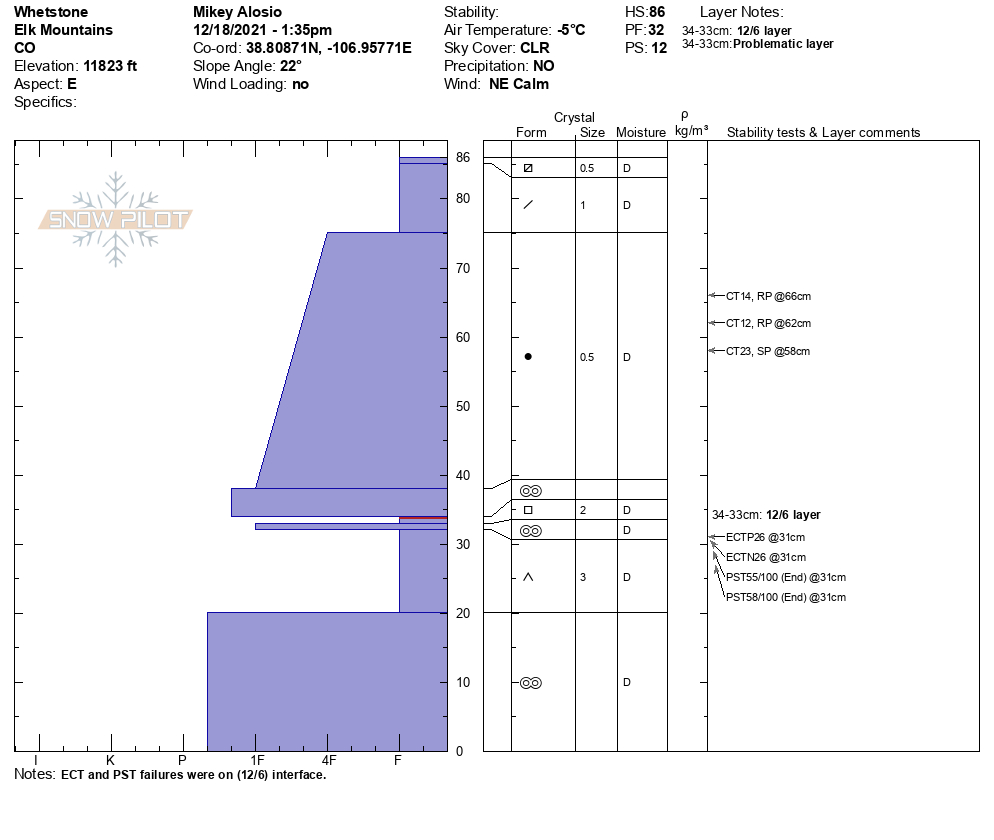
With each passing day of dry and calm weather, the sensitivity of persistent slabs gradually decreases. In shallow areas, slabs are decaying, and in deeper areas, the snowpack is settling and gaining some strength. Stability tests from the last few days are showing improvements compared to earlier in the week (Example AExample B). While the weekend passed with fewer reports of collapses than last week and more reports of a weakening snowpack structure. Our last reported persistent slab avalanche was skier triggered on December 12th. This all highlights an improving trend for now. 

We are in the last couple of days of these relatively more mild avalanche conditions. Once the next storm arrives it will be a quick rise back to dangerous avalanche conditions. The current snowpack is once again exceptionally weak thanks to the continued cold and clear weather we have had. Another natural avalanche cycle is expected for later this week, as the CBAC expects to begin a long march beating the drum about the dangerous avalanche conditions lining up for the holidays. 

Tonight: Fireside Chat Speaker Series #2

Graham Sexstone is a Research Hydrologist with the USGS Colorado Water Science Center. Graham will be presenting on USGS snow monitoring and modeling activities in the Upper Colorado River Basin and will highlight research efforts planned in and around the greater Crested Butte and Gunnison areas. This research is focused on better understanding snow as a water resource and linking snowpack to streamflow.

Regioni coperte