
Quick report
- Aspect
- East
- Red Flags
- Poor Snowpack Structure
- Elevation
- 3018 m
Today we traveled out to Bald Mountain Pass via the Soapstone trailhead departing around 0900. The ride in was frigid, temperatures in the single digits (farenheit). The sun was out for the greater part of the morning as the next small front rolled in behind it. Around 1200 skies became broken and light flat at times. Winds were calm for the most part out of the south and no visible snow transport was observed.
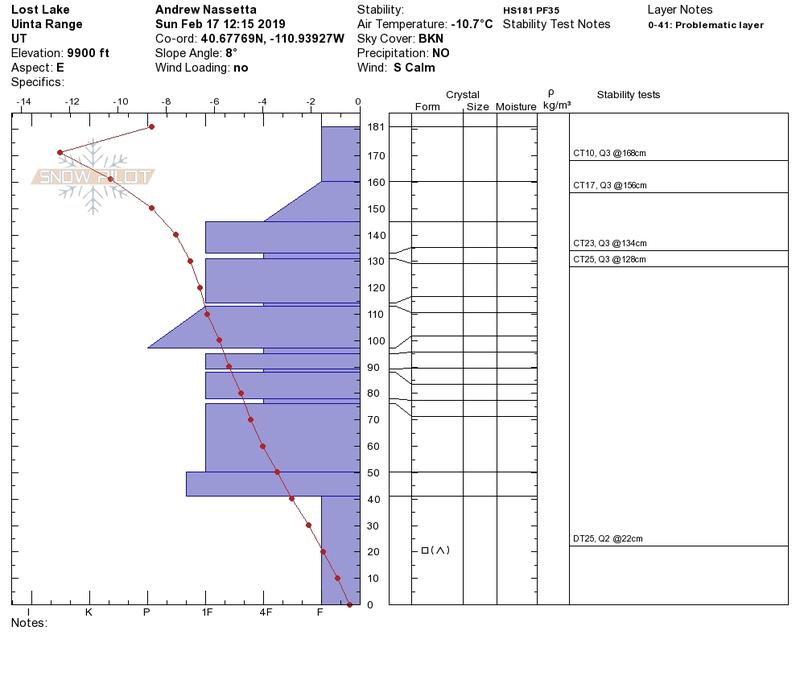
There was little recent activity seen throughout our day, though old avalanches were noted and are a good clue. A snowpit at 9900' provided a great example of poor structure, as well as pointed out the culprit of many large, and even fatal avalanches that have occurred recently.
The take away from today was that the range is having a great season, and hopefully an even better spring. Until then we have to be patient and let the snowpack heal. Sometimes patience is difficult, but so is trying to outthink the snowpack. Here's the out: riding conditions continue to be stellar in protected terrain at mid to low elevations. This is where we can ski and ride in low angle terrain, boondock mellow trees and find the best snow while avoiding the persistent weak layers all together.
Photos1-3 Recent activity observed today on the east face of Bald Mountain. Most Likely occurred on Friday when the winds ramped up ahead of the front
Photos 4-5
Larger windslab off the south east ridge that also released prior to the storm (lookers left of previous photos).
Photo 6
Evidence of wind at work on the north ridge of Bald Mtn.
Photos 7-8
Poor structure is seen here at the bottom of the snowpit where the weak, sugary faceted snow is the “foundation” for a strong, cohesive slab above it. Strong over weak, big red flag.
Snowpack
- Instability Comment
- <p> Trying to understand these avalanches makes my head hurt. When that happens the best thing to do is keep it simple. We know the problem exists, we can see it in our snow pits. Over the past few weeks, we’ve seen multiple avalanches breaking 6’-10’+ feet deep and hundreds of feet wide. This avalanche problem is responsible for the 4 avalanche fatalities we’ve had in Utah this winter. Right now the way to manage this problem is to AVOID IT! Which has been easy this weekend since riding conditions are excellent on mid to low elevation slopes sheltered from the wind. There is incredible coverage in the Bald Mountain Pass area and when things finally turn the corner for our snowpack it’s going to be a great spring. So for now, get out and ride but avoid upper elevation terrain. </p> <p>Winds were relatively calm during this weeks storm compared to our last 2 weeks. Nevertheless, winds still had effected upper elevation slopes on all aspects and created very large wind slabs. We only noticed 2 wind slab avalanche during our travel today but both subsequently triggered larger Persistent Slab Avalanches.</p>