Bulletin d’avalanche

Northwest Mountains

Crested Butte Avalanche Center
Voir sur la carte

Danger d’avalanche

Wed
Alpin
4 · Fort
Limite forestière
4 · Fort
Sous la limite
3 · Marqué
Périmé — ce bulletin a expiré 4 years ago. Vous consultez des conditions passées, pas le bulletin en cours.

Points saillants

An AVALANCHE WARNING remains in effect for the Northwest Mountains.  The final pulse of snow and wind today is stressing weak layers that have been producing large and dangerous avalanches in the past few days.  Wind-loaded slopes are likely to produce more destructive natural avalanches today.    You can easily trigger a large avalanche from on, near, or below steep terrain, and natural avalanches could run into flat terrain from above you.  Travel in avalanche terrain is not recommended, especially below leeward start zones. You can safely enjoy the new snow by staying on slope angles less than about 30 degrees without overhead hazards.

Problèmes avalancheux

  • Persistent Slabs

    • Alpin
    • Limite forestière
    • Sous la limite forestière
    Probabilité
    Likely
    Taille
    2–3.5

    Persistent weak layers in the middle and bottom of the snowpack are being overloaded by impressive snowfall this week. Destructive avalanches have released around the compass and at all elevations over the past few days, and plenty of other slopes are just hanging in the balance waiting for a human trigger. Persistent slab avalanches can propagate widely through the terrain, or be remotely triggered from low-angle slopes connected to steeper slopes. Leeward start zones near and above treeline are likely to produce very large triggered or natural avalanches (D3+), and large persistent slabs (D2) are sensitive to human triggers on some slopes below treeline.    You can avoid the problem by traveling on slope angles that are consistently less than 30 degrees without overhead hazards. Give yourself a wide margin for error given how consequential the problem is right now.  

  • Wind Slabs

    • Alpin
    • Limite forestière
    • Sous la limite forestière
    Probabilité
    Likely
    Taille
    1–2

    Up to a foot of new snow last night and today paired with moderate westerly winds will form sensitive drifts on leeward slopes at higher elevations.  These drifts are hazardous by themselves, but they could also step down and trigger a much larger persistent slab.  Avoid travel on or below drifted slopes.  

Avalanche Discussion

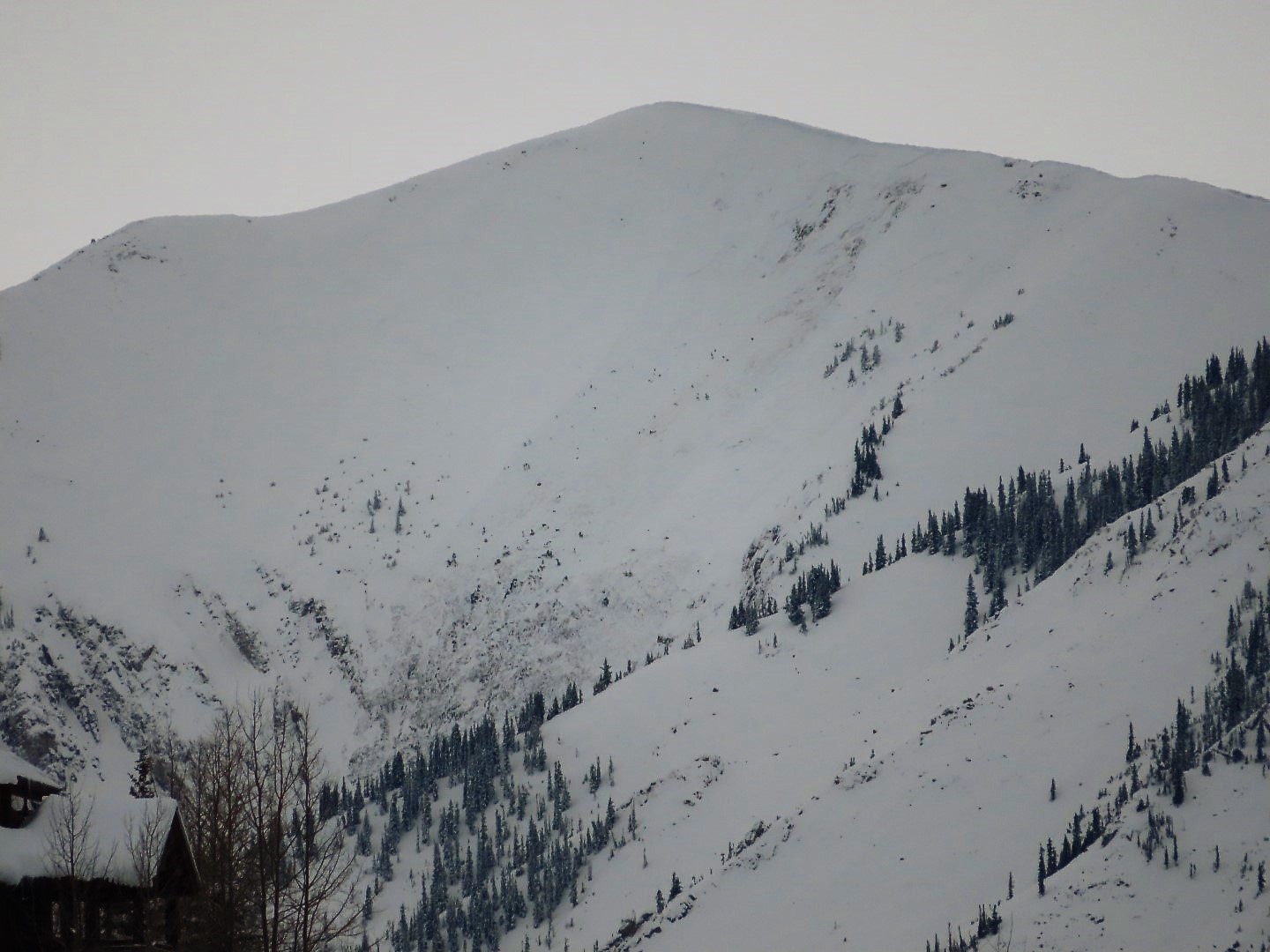
The mountains picked up 2" to 8" overnight with similar snow totals expected today.  This new snow is relatively low-density compared to what we saw over the weekend. Thus, new storm slab formation may be limited.  Our biggest concern today is that the new snow is easily transportable by the 20 to 30 mph winds at alpine locations.  Wind transport will continue to stress buried weak layers that reached their tipping point over the weekend.  We have had limited visibility of high-elevation terrain this week, so there's a fair amount of forecaster uncertainty with how much avalanche activity today's wind loading will produce.  Avoiding travel on or in the runouts of leeward start zones is prudent given that more natural activity is expected.  Leeward start zones could produce very destructive avalanches that run far into their runouts, like this recent avalanche on Whetstone.  The threat of natural avalanches is lower in wind-sheltered terrain, but you can easily trigger a dangerous avalanche at all elevations today.  Terrain closer to and east of town has proven to be especially reactive to human triggers (see video), where slabs are ideal depths for human triggering and buried weak layers are most fragile.  

We're just starting to gather data on the patterns and characteristics of the ongoing avalanche cycle brought about by significant loading in the past week (Over 5" SWE at Schofield Pass and 2.5" of SWE at Mt. Crested Butte). The most obvious pattern, unfortunately, is that we have documented large avalanches breaking on almost every aspect and elevation. That’s because our mid-December facets, faceted crusts, and surface hoar layers formed around the entire compass.  On low-elevation, south-facing slopes near town, the faceted crusts and slabs are embedded in sagebrush and other vegetation, making avalanches less likely on those types of slopes.  Otherwise, all terrain is capable of producing a persistent slab today.  Another variable at play is the wind effects from the arctic blast prior to the big storm.  In some terrain, those previous winds either completely removed the snowpack, or damaged the weak layers that were forming at the surface (recall this video).  Preliminary observations suggest that the most wind-damaged slopes were less active during the cycle.  The spotty surface hoar event that occurred after the artic blast threw some jokers in the deck.  This all means that there’s spatial variability out there, and you would need to very carefully assess the snowpack structure on a slope by slope basis if you are considering avalanche terrain.  

Régions couvertes