

Bulletin d’avalanche

Southeast Mountains

Crested Butte Avalanche Center
Voir sur la carte

Danger d’avalanche

Tue
Alpin
2 · Modéré
Limite forestière
2 · Modéré
Sous la limite
2 · Modéré
Périmé — ce bulletin a expiré 5 years ago. Vous consultez des conditions passées, pas le bulletin en cours.

Points saillants

The danger continues its gradual downtrend under our quiet weather pattern.  Although avalanches are becoming harder to trigger,  they remain a concern on the northern half of the compass.  On these shadier aspects, you can trigger a large slab avalanche that breaks several feet thick on weak layers near the ground.   Collapses and shooting cracks are signs of unstable snow.  The safest riding is on southerly aspects or on slopes that avalanched during the cycle earlier this month.  

Problèmes avalancheux

  • Persistent Slabs

    • Alpin
    • Limite forestière
    • Sous la limite forestière
    Probabilité
    Possible
    Taille
    1–2

    Persistent slabs up to several feet thick are becoming more stubborn to human triggers and they may not alert you to their presence with obvious signs of instability. The problem is on the north half of the compass, where the foundation to our snowpack is weak and faceted. In steep terrain, the distribution of these slabs is variable because of a widespread cycle earlier this month.  Be cautious of steep terrain where you find strong over weak structure, especially in terrain with recent wind loading.  Remember, persistent avalanches can also be remotely triggered from flat terrain below a steep slope, and avalanches might propagate much wider than you expect. Choosing lower slope angles or southerly facing slopes is the easiest and most reliable way to avoid this problem.

    This widely propagating persistent slab ran naturally on December 10th on Mt. Axtell. 
Avalanche Discussion

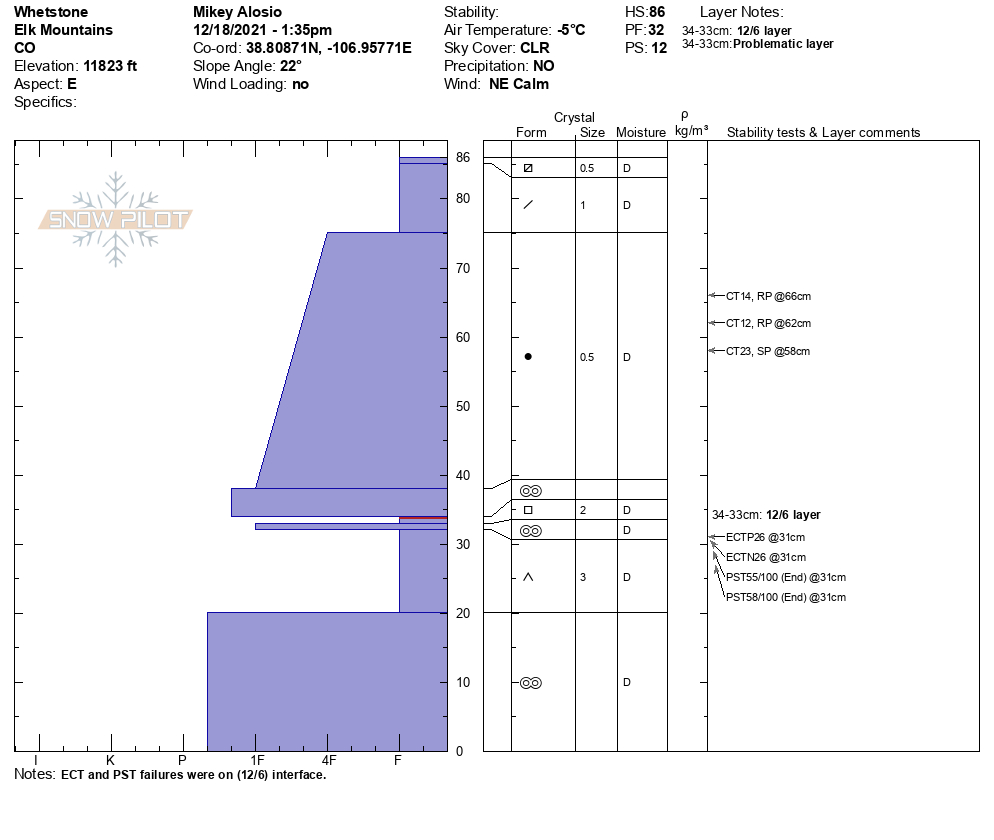
With each passing day of dry and calm weather, the sensitivity of persistent slabs gradually decreases.  In shallow areas, slabs are decaying, and in deeper areas, the snowpack is settling and gaining some strength.  Stability tests from the last few days are showing improvements compared to earlier in the week (Example A, Example B), and the weekend passed with fewer reports of collapses than last week.   Our last reported persistent slab avalanche was skier triggered on December 12th.  This all highlights an improving trend for now.  This trend will reverse abruptly on Thursday with significant snow in the forecast.

It's an improving trend but the consequences have not changed and our concerns remain the same.  If you trigger a slab, it will break several feet thick, which is large enough to injure or bury you.   Slabs are a bit thinner and easier to trigger below treeline in the Southeast Mountains, although many of those shallower slabs are faceting away now.   Be cautious of steep, shady terrain in sparse glades where you find the entire season's snowpack still intact.   Even a small slide in that type of terrain will carry you into trees.   Near and above treeline, persistent slabs are thicker and more difficult to trigger.  Unless you pause to dig into the snowpack, feedback is uncommon with this type of setup.  You might go the whole day without seeing a sign of instability, or you might hit the sweet spot on the wrong slope and bring down a large avalanche that breaks widely above you.  Although I don't have any recent examples in our forecast area to point to,  this avalanche from Saturday in Summit County is an example, as is this one from the San Juans earlier in the week.  The snowpack is more variable above treeline and harder to assess.  Here are a few strategies if you want to take advantage of the nice weather to travel in the alpine.  1) Choose routes on southerly aspects, where weak layers don't exist at the bottom of the snowpack.  If you are accepting greater risk and traveling on the northern half of the compass, then 2) Choose smaller terrain features with cleaner runouts, devoid of gullies.  And 3) Be skeptical of slopes that received the most recent wind loading, primarily on the northeast quadrant of the compass.  You can feel more confident traveling in steep terrain where slabs were eroded by the extreme wind event last week or where avalanche activity during the last cycle cleaned out the slab.   

Régions couvertes