Storm Slabs
N
NE
E
SE
S
SW
W
NW
- Alpine
- Treeline
- Below treeline
- Likelihood
- Likely
- Size
- 1–2
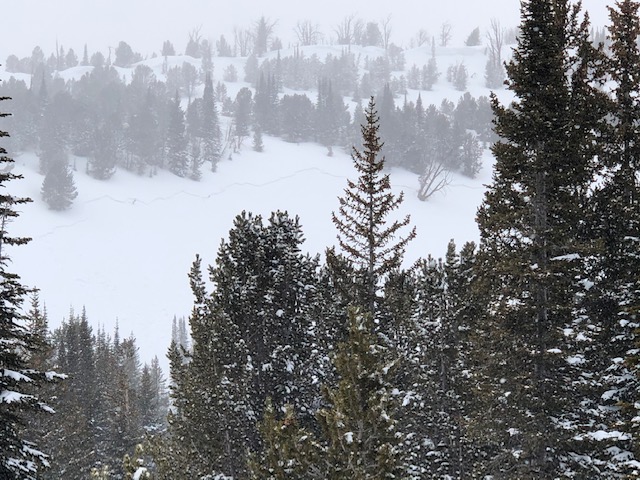
Many slides released naturally Monday and Tuesday. With 2-3 feet of snow earlier this week, we're facing a variety of "new snow" problems:
- Wind slabs: Expect to find soft and stiff, 1-4 foot thick wind slabs in exposed terrain. They will be most widespread near ridgelines at upper elevations, but the recent storm's erratic winds may have built slabs in unusual places lower on slopes as well. Watch for cracks shooting from your boards or sled, a red flag that says "caution, unstable snow." If the snow gets stiffer or deeper while you're traveling, you found a wind slab.
- Storm slabs: We observed many natural avalanches that appeared to fail within the storm snow or at the interface between the storm snow and the old surface. Push, pull, and play with the snow as you're traveling to see if it breaks cleanly within the new snow or at the interface.
- Loose snow avalanches: You're likely to trigger dry loose slides (sluffs) within the new snow on slopes approaching about 40 degrees in steepness. On slopes directly facing the sun, expect some natural loose snow activity. The April sun can quickly cause things to come unglued; watch for signs things are changing, and think on a scale of minutes rather than hours.
- Cornice: Small pieces of cornice could naturally break, triggering wind slabs or loose snow avalanches on steep slopes beneath them. Cornices grew quite large this week. Stay away from the edges, and give them a wide berth.
Approach all steep slopes cautiously. Think about the consequences of an avalanche on any slope you're considering skiing or riding. Where will an avalanche carry you? If you would be carried through trees, dragged into a creek or gully, or pushed through rocks, the prudent move is to head for gentler or more forgiving terrain.