Persistent Slabs
- Alpine
- Treeline
- Below treeline
- Likelihood
- Possible
- Size
- 1.5–2
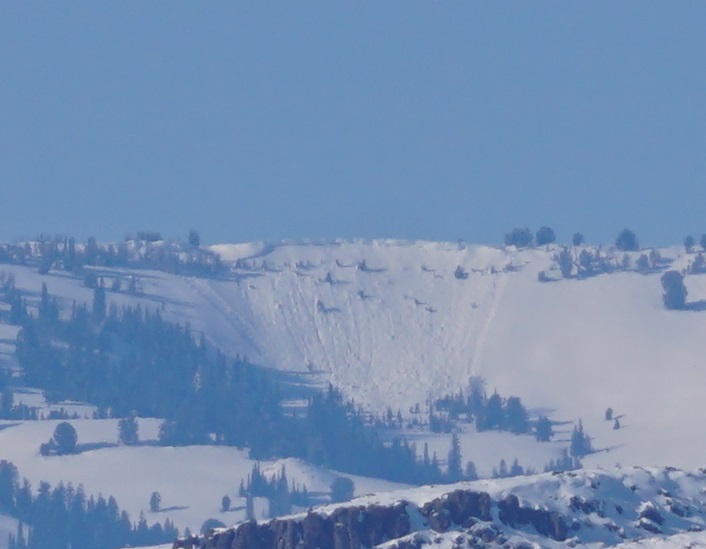
In the past two weeks, skiers and riders triggered several avalanches involving a layer of surface hoar buried 1.5-2 feet deep. A skier triggered a slide on this layer Sunday in the Salmon River drainage (view report). The surface hoar "problem" remains capable of producing avalanches on some slopes steeper than about 35 degrees.
Buried surface hoar is challenging to deal with. Its patchy distribution means you may find it on one slope but not the next, and it can be hard to identify when searching for it in a snowpit (see photo to right/above). It's often best preserved and more sensitive in small clearings and open, wind-protected terrain on shadier aspects.
You can reduce your risk by avoiding slopes facing NW-N-NE that are steeper than about 35 degrees. Consider the consequences of going for a ride. Even small slides can have bad outcomes if they lead to trees, cliffs, or a creek bed.
ADDITIONAL DISCUSSION: Older weak layers (often facets found near crusts, with some surface hoar) exist deeper in the snowpack. These layers are buried beneath dense, 3-4+ thick slabs. While triggering them is unlikely, it can't be ruled out in steep, rocky, wind-affected terrain.
A skier triggered this 1-2 foot thick avalanche on Sunday Jan 29th on a N-NE aspect at 9100' near Titus Ridge. It failed on a layer of buried surface hoar.