Avalanche forecast

Gunnison

Crested Butte Avalanche Center
View on map

Avalanche danger

Tue
Alpine
2 · Moderate
Treeline
2 · Moderate
Below
2 · Moderate
Out of date — this forecast expired 5 years ago. You’re viewing past conditions, not the current bulletin.

Highlights

Several large hard slab avalanches up to several feet thick were remotely triggered over the weekend (See this video and this observation).  Avoid traveling on or directly below recently wind-loaded terrain where the snow surface is smooth and dense.   Slabs can break unpredictably above you and some are large enough to bury you.   Instabilities are easier to manage in wind-sheltered terrain.   Where the snow surface is soft and sugary in protected northerly terrain, skiers and riders are still triggering loose dry avalanches in steep terrain on a daily basis.   All of these issues will be magnified if you get carried into a terrain trap.

Avalanche problems

  • Persistent Slabs

    • Alpine
    • Treeline
    • Below treeline
    Likelihood
    Possible
    Size
    1–2

    Strong northwesterly winds last week raked the mountains and mixed into typically more sheltered locations.  The incremental wind drifting built hard slabs ranging from just a few inches to several feet thick.  Although you can find these slabs at any elevation, we've seen the most significant wind loading and slab formation occurring nearing treeline, especially in terrain with large fetches favored by northwest winds.   These slabs are slower to heal because they formed above exceptionally weak facet layers.  They can also be remotely triggered from below or adjacent to steep slopes where the drifted snow spans onto lower slope angles.   The problem is localized to leeward terrain features and most often appears on the surface as smooth, dense, lens-shaped deposits behind tree fences, on the lee sides of ridged terrain features, and in concave catchments such as gullies.   Collapses and shooting cracks are clear warning signs of the problem.  Give wind-loaded terrain a wider berth than normal: there have been several near misses this week with some slides breaking into lower-than-usual slope angles.

  • Loose Dry

    • Alpine
    • Treeline
    • Below treeline
    Likelihood
    Likely
    Size
    1–1.5

    Dry loose avalanches (sluffs) are a concern in wind-sheltered terrain on the north half of the compass.  Where the snow surface is weak and cohesionless, you can easily trigger sluffs that entrain the top 6" to 10" of loose snow on slopes steeper than 35 degrees. Ski cuts, moving across the fall-line while descending, or choosing lower-angled slopes are effective techniques to manage this problem. These point-release avalanches will accumulate more mass in long-running, steep terrain. Use caution above gullies where an avalanche can pile more deeply and above trees and cliffs where the consequences of getting caught in a small sluff will be magnified. This problem is most common in sheltered terrain below treeline, but you can also trigger sluffs on some near treeline slopes and a few above treeline slopes.     

Avalanche Discussion

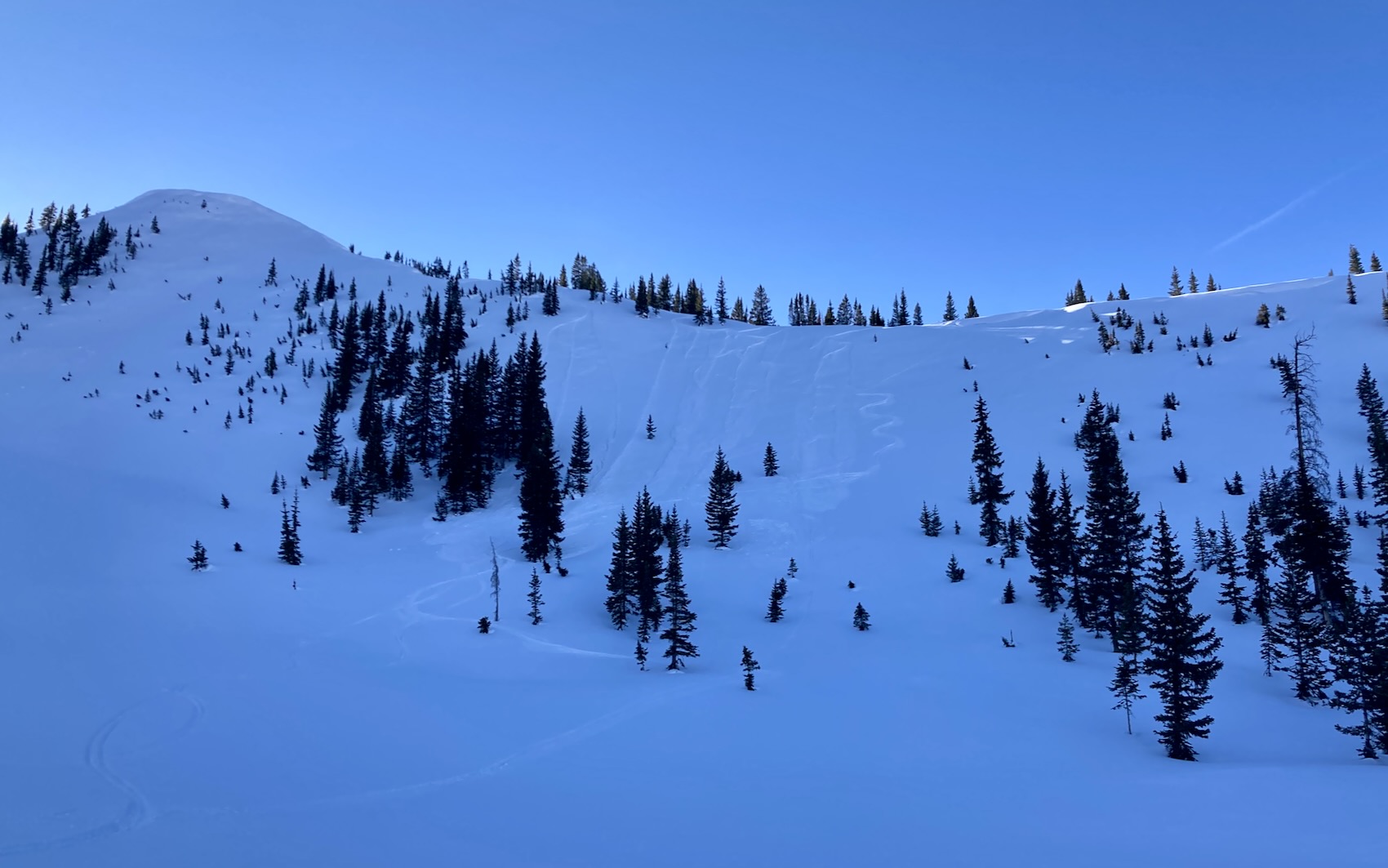
Let's compare two photos that were submitted with observations yesterday.   Photo #1 from Gothic and Photo #2 from Mt. Emmons.  The terrain shares a lot of similarities:  Sparse glades, East to Northeast facing, mid-elevations.  The slope on Gothic produced a dangerously large hard slab avalanche that would have buried you.  The slope on Mt. Emmons produced a handful of small skier triggered loose dry avalanches that could have knocked you over or pushed you into trees.  The latter is a friendlier problem that I'd rather deal with because sluffing is predictable and manageable.  From a distance, it's hard to differentiate between those slopes, but if you are traveling on them, the contrast will be obvious.  The snow surface on Gothic would have been textured by winds, with very hard snow surfaces where the avalanche broke.  The snow surface on Emmons would feel soft and offer higher quality recycled powder riding.   If you can sniff out the softer riding today, you can easily avoid our persistent slab problem.   If you are riding at higher elevations, you inevitably will be traveling through firm snow. If that's the case, read the snow surfaces to help you avoid the persistent slab problem.  If the snow surface is rippled and wavy (sastrugi), it means there's no slab.   If the snow surface is smooth and chalky, you might be on a slab.  Our media gallery below has some examples of what that looks like.  

During typical stormy weather, slab formation is typically driven by a combination of snow and windloading.  Right now, our persistent slabs have formed exclusively from wind loading.  The size of the slab depends solely on how much wind transport has occurred onto a leeward terrain feature.  In many cases, these slabs are still very thin (a few inches) and relatively harmless in size. It appears that in a lot of alpine terrain, winds were too strong for effective wind loading, and instead, saw more scouring.  In some cases, slopes caught steady wind drifting from a huge amount of upwind terrain, called a fetch, and thus have surprisingly thick slabs (Example A, Example B).   So with a keen eye for reading wind loading vs. wind erosion textures, and a good understanding of what the fetch of each terrain feature looks like, you can move around in steep wind affected terrain and manage the problem as well.  It requires more caution and the consequences of getting caught in a hard slab are likely to be worse.  Windloaded slopes with large and effective fetches are the most dangerous, but of course, any slope where you can get dragged into trees, gullies, or rocks can be trouble.  

Regions covered