Natural avalanches unlikely, human triggered possible.
Treeline
Natural avalanches unlikely, human triggered possible.
Below Treeline
Natural avalanches unlikely.
Alpine
Natural avalanches unlikely, human triggered possible.
Treeline
Natural avalanches unlikely, human triggered possible.
Below Treeline
Natural avalanches unlikely, human triggered possible.
Regions
Stevens Pass.
The Bottom Line: If you travel near ridgelines or on exposed slopes near and above treeline, you may see areas where the wind has drifted the new snow into firm slabs. You are most likely to trigger an avalanche where these rest on steep slopes.
Snow and Avalanche Discussion:
Winds were moderate to strong from the East until the early morning hours of the 6th, then they switched back to Westerly. The loading pattern may be tricky because of this switch in wind direction. During the day on the 6th, an observer was able to trigger a small wind slab on a very steep slope near Lichtenberg Mountain. This was on a Northeast aspect at 5,200ft. The slab was 10" deep and 20ft wide. Another observer reported wind loaded slopes and cracking in the snow on West facing slopes near Skyline. A number of small loose avalanches were noted off the steep Southeast side of Lichtenberg, likely running on the stout melt freeze crust from January 3rd.
Regional Synopsis
January 6, 2019
This latest round of storms in early January continues to highlight some of this season’s region-wide themes in our snowpack. I’d describe them as Bottom to Top, North to South, and East to West. Let’s take a look at each of these.
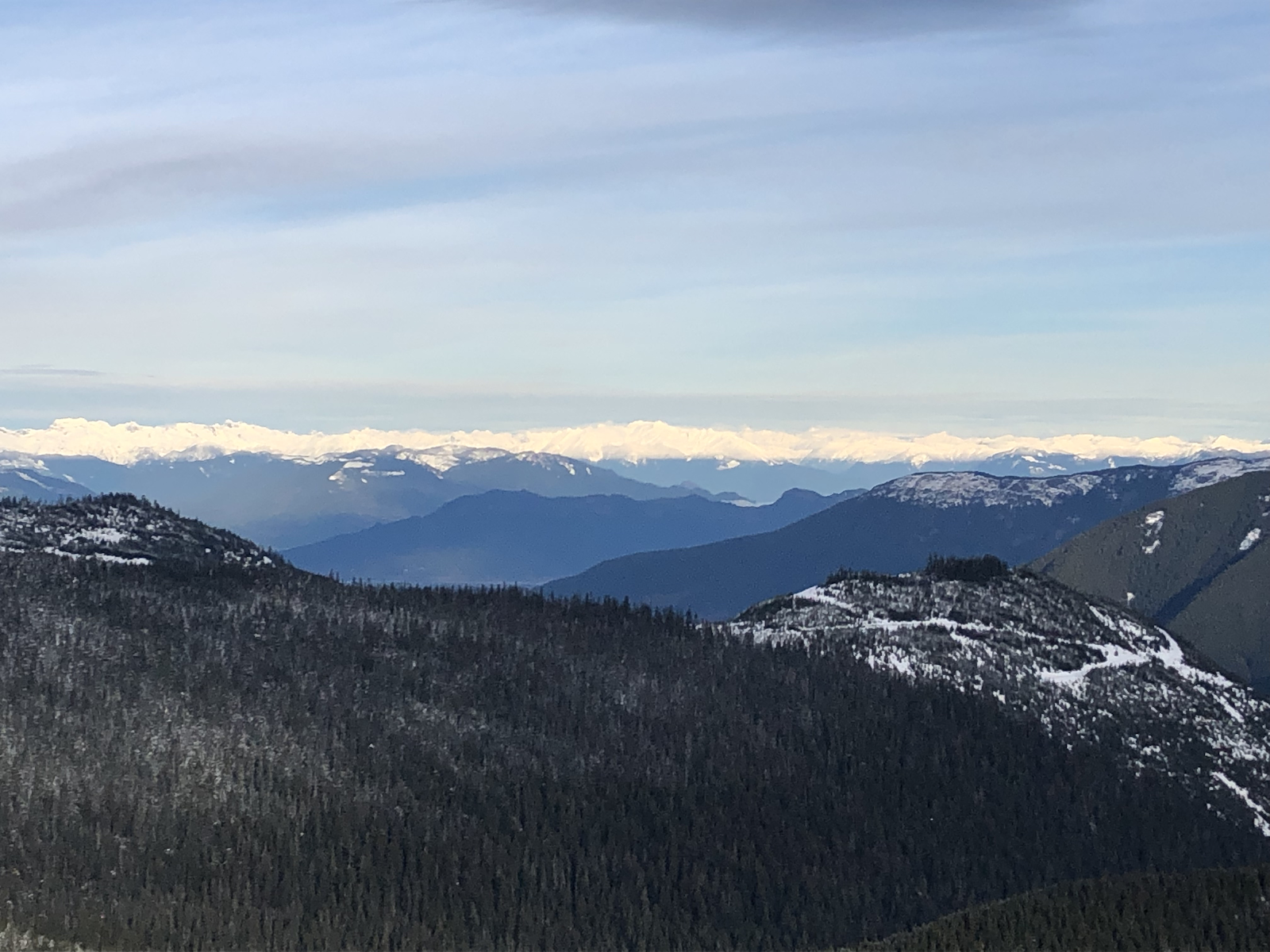
Bottom to Top: In general this winter has been on the warm side in the Cascades. No where is that more evident than in the lack of low elevation snow. Heavy rain events continue to wash-away and thoroughly wet the lower elevation snowpack. In most regions you will see substantial increase is the height of snow from low elevations (3000 ft), to mid elevations (4500 ft), and again at upper elevations (5500/6000 ft). Above the typical rain lines (5000-6000 ft) a deep and cold mid-winter snowpack exists.
Jan 5, 2019: The dark timber in the Coast Range highlights the thin snowpack at lower elevations and the deeper winter-like snowpacks near and above treeline: Photo: Simon Trautman
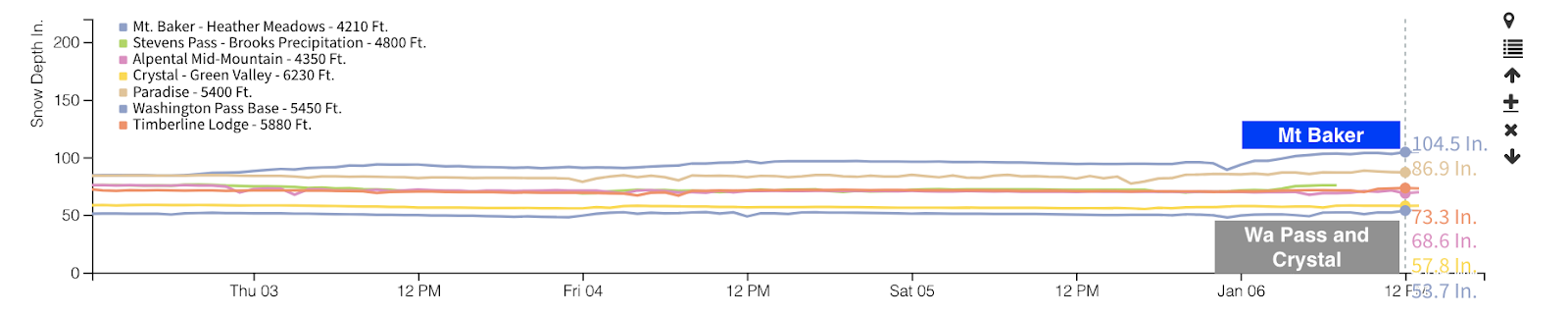
North to South: With few exceptions, this season’s storm tracks have favored the North Cascades. Sunday, Mt Baker’s Heather Meadows weather station passed 100 inches of snow on the ground. A quick look around the state’s weather stations demonstrates just how deep this snowpack is. Most other locations are reporting between 50 and 75 inches. The massive amounts of snow for the northern forecast zones are reflected in several impressive avalanche cycles spread out over the last month.
NWAC weather station graph of the height of snow on the ground. Mt Baker passed the 100 inch mark Sunday.
East to West: Several stacked persistent weak layers have been buried in the eastern forecast zones. This isn’t unusual, but it is noteworthy. The thickness of the slabs over these weak layers can vary greatly. Closer to the Cascade Crest, the deep snowpack may more closely resemble Stevens or Snoqualmie Passes. Further east, shallower snowpacks, and significant variability are keeping snowpack assessment tricky.
Canadian sized surface hoar found buried by 18” of snow in Icicle Creek above Leavenworth on December 31st: Photo by Matt Primomo.
So what now? Well, on January 3 and 4 a high elevation rain event impacted areas from Mt Baker to Mt Hood. In many locations this has created a firm and thickening crust. In these locations, this new crust is limiting the impacts of any deeper weak layers. In locations that didn’t receive as much rain like WA Pass, Mission Ridge, Crystal Mt, and White Pass, how the small amount of rain impacted the mid and lower snowpacks remain to be seen.
Rain and rime crust at 6,500ft above Gallagher Head Lake in the East Central Zone, Jan 5th. This layer was 3 inches thick in this location. Matt Primomo photo.
One thing is for sure, we’re not even a month into the winter season, there’s a lot more winter to come.
Problems
Wind Slabs
Wind Slab avalanches are the release of a cohesive layer of snow (a slab) formed by the wind. Wind typically transports snow from the upwind sides of terrain features and deposits snow on the downwind side. Wind slabs are often smooth and rounded and sometimes sound hollow, and can range from soft to hard. Wind slabs that form over a persistent weak layer (surface hoar, depth hoar, or near-surface facets) may be termed Persistent Slabs or may develop into Persistent Slabs.