Natural avalanches unlikely, human triggered possible.
Treeline
Natural avalanches unlikely.
Below Treeline
Natural avalanches unlikely.
Alpine
Natural avalanches unlikely, human triggered possible.
Treeline
Natural avalanches unlikely.
Below Treeline
Natural avalanches unlikely.
Regions
Snoqualmie Pass.
The Bottom Line: Expect the warmest temperatures of the winter, so far. Warming, sun, and uncertainty of the snow layers at upper elevations will maintain heightened conditions. If you are heading to higher slopes, use caution on slopes 35 degrees and steeper.
Snow and Avalanche Discussion
With warming and sun, uncertainty about the snowpack is increasing. Most loose wet avalanches you will see are a few days old. Watch for wet avalanches if you see soft, wet snow on sunny slopes and at low elevations. The lower elevation snowpack continues to creep and glide under the weight of recent rains. While no glide avalanches have been reported, they are on our mind. If you see crevasse like features on a slope, limit you exposure by avoiding traveling on or below these areas.
Expect difficult travel conditions at lower elevations including breakable crust, wet heavy snow, and open creeks.
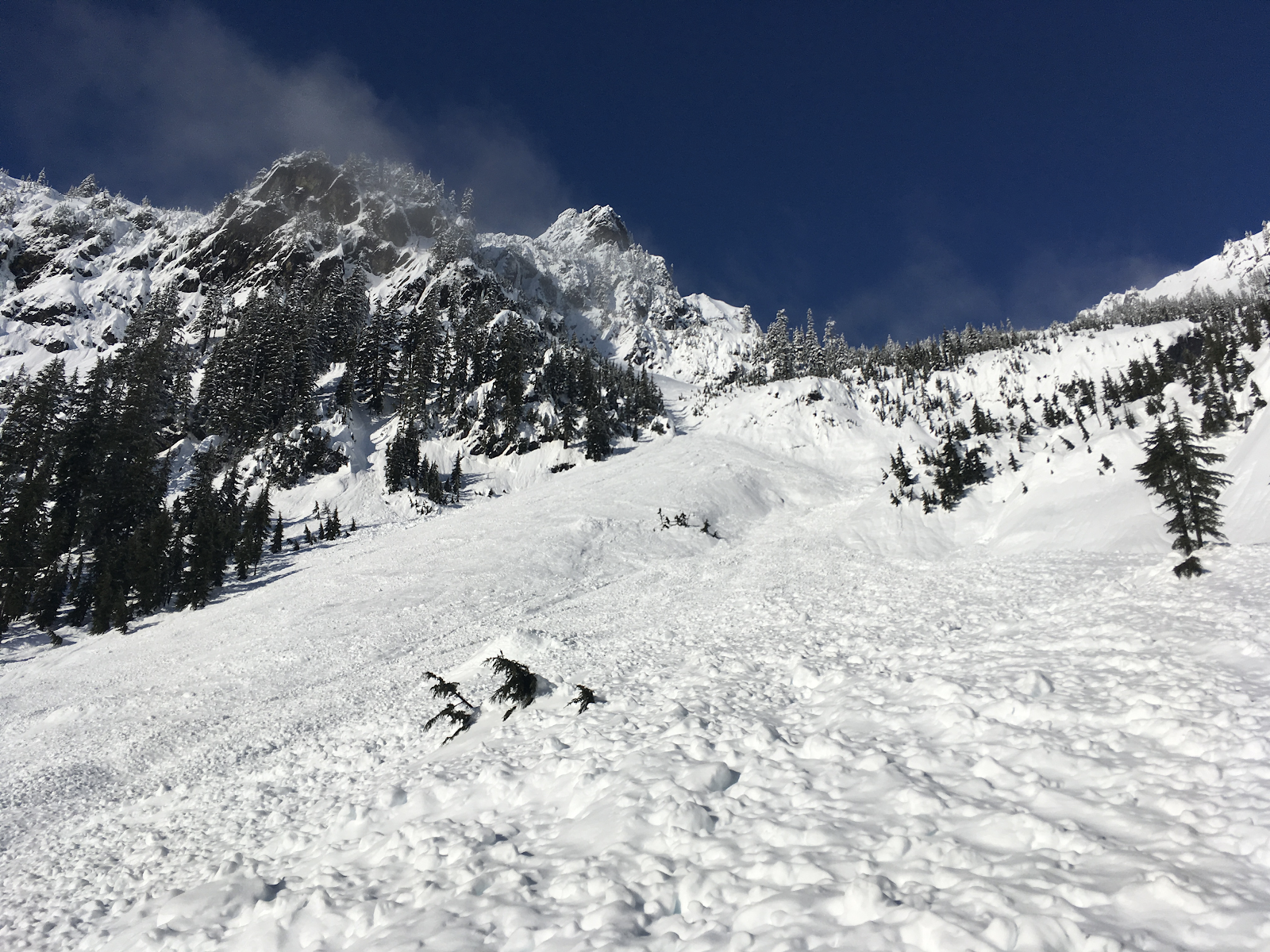
Evidence of Wednesday’s avalanche cycle is easy to find. Debris from several large and very large avalanches Has been reported around the Alpental Valley. Check out the Regional Synopsis for more details of recent avalanches and conditions.
Very large natural avalanches on Chair Peak from Wednesday’s avalanche cycle: Photo: Jeremy Allyn
Problems
Wind Slabs
Wind Slab avalanches are the release of a cohesive layer of snow (a slab) formed by the wind. Wind typically transports snow from the upwind sides of terrain features and deposits snow on the downwind side. Wind slabs are often smooth and rounded and sometimes sound hollow, and can range from soft to hard. Wind slabs that form over a persistent weak layer (surface hoar, depth hoar, or near-surface facets) may be termed Persistent Slabs or may develop into Persistent Slabs.