

Avalanche forecast

Southeast Mountains

Crested Butte Avalanche Center
View on map

Avalanche danger

Sun
Alpine
3 · Considerable
Treeline
3 · Considerable
Below
3 · Considerable
Out of date — this forecast expired 4 years ago. You’re viewing past conditions, not the current bulletin.

Highlights

A Special Avalanche Bulletin is in effect because avalanche conditions are especially ripe for a deadly accident this weekend.  A horrendous weak layer has been producing extensive natural and remotely triggered avalanches all week.  On slopes that haven't already flushed, you can easily trigger a dangerous slab that breaks several feet thick from on or below a steep slope.   Natural avalanches are possible.  Make a conservative plan today and don't let the powder and blue skies draw you into suspect terrain that is well defined below.  Riding on slope angles that are consistently less than about 30 degrees is the most reliable way to manage today's dangerous conditions.  

Avalanche problems

  • Persistent Slabs

    • Alpine
    • Treeline
    • Below treeline
    Likelihood
    Likely
    Size
    1–2.5

    You can easily trigger slabs 1 to 3 feet thick that fail on fragile facets and faceted crusts below the recent storm snow.  Avalanches can be triggered from below steep slopes and they can propagate surprisingly wide distances.  A few could fail naturally today. There is a mountain of evidence showing that the problem is easy to trigger and most suspect on west to north to southeast aspects. Due to the very sensitive nature of the weak layer below, you can expect similar conditions today.  Choose slopes that are consistently less than about 30 degrees that don't connect to steeper terrain above you to manage the problem.  

    Fresh and recent persistent slab activity observed yesterday near Schuylkill Peak.
Avalanche Discussion

Our observations page and media gallery below tell the horror story of dangerous conditions in the Crested Butte backcountry.  The snowpack is caught in the crosshairs of an unusually fragile weak layer and slabs that are the perfect thickness for human triggering.  Yesterday's observations continue to show widespread signs of instability (shooting cracks and rumbling collapses), along with ongoing natural avalanches in wind-loaded terrain at higher elevations.  Avalanches are breaking 1 to 3 feet thick on the exceptionally weak, faceted layer that formed during our long drought this year.  

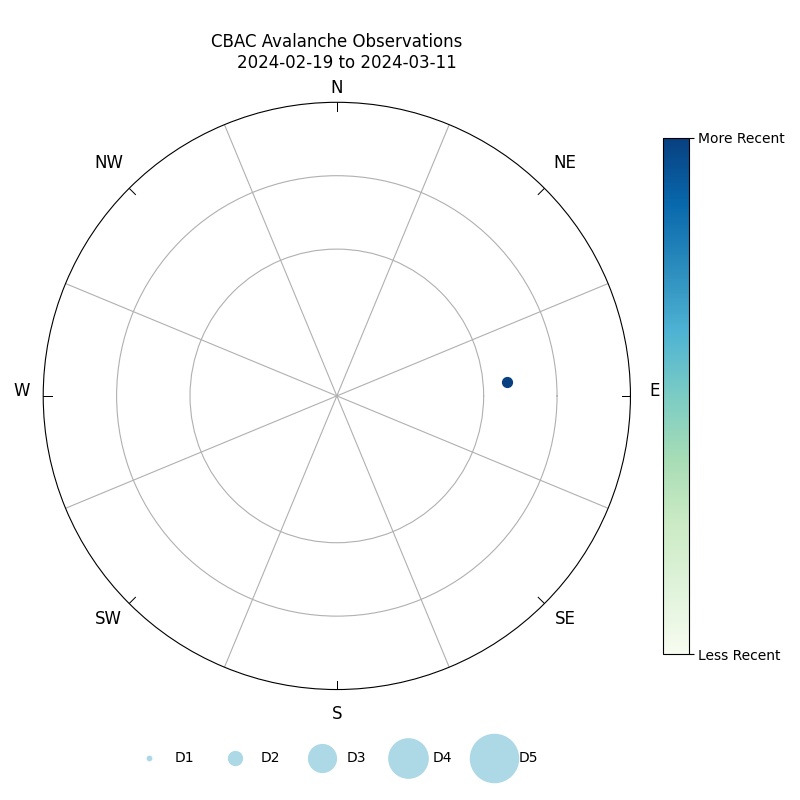
With the extensive avalanche activity observed this week, we can flush out a few patterns.  Check out our avalanche rose:  each dot represents a recent avalanche, coded by size.  Near and below treeline, you can see a very impressive amount of avalanches on west to north to east aspects.  That's where our facet layer is weakest and most widespread.  Avalanche sizes tend to be a bit smaller below treeline because there are a lot of smaller paths at lower elevations and they don't get the wind loading.  That west to north to east facing terrain is clearly very dangerous unless you are on a slope that has already avalanched.  Natural activity has been less common on the southern quadrant because those facet layers are capped by thicker crusts.  Those crusts get thinner at higher elevations or as you move further from due south.  Southeast aspects have produced a number of scary avalanches because once the crust collapses, it drives failures especially far.    You might also notice that we have documented fewer avalanches at higher elevations.  The main reason is that we haven't had good visibility above treeline all week.  In some alpine terrain that was blasted by previous northwest winds, the weak layer was beaten up before the storm, so poor structure is not as widespread.  This week, I've noticed a handful of slabs that have broken lower in start zones than normal because of how the weak layer is distributed. That means you might not find obvious signs of instability near ridgetop, but halfway down the slope, BOOM. Avalanche.  Assessing the presence or absence of a weak layer in alpine terrain is a gamble unless you've invented X-ray vision recently.  

So what's the takeaway?   I do not trust anything steep that faces west to north to southeast right now unless I'm on a bedsurface.  At higher elevations, you may encounter some variability and a quieter snowpack in places. Don't take that as a sign to step out; ongoing naturals above treeline yesterday trump all other evidence.  With careful snowpack assessments, you may be able to ride on some steeper south to southwest facing terrain with lower risk, but only do so if you've ruled out the potential for recent cross drifting or slabs breaking on or below those thicker crusts.    

Regions covered