

Avalanche forecast

Southeast Mountains

Crested Butte Avalanche Center
View on map

Avalanche danger

Thu
Alpine
2 · Moderate
Treeline
2 · Moderate
Below
2 · Moderate
Out of date — this forecast expired 5 years ago. You’re viewing past conditions, not the current bulletin.

Highlights

Wednesday looks like an absolutely beautiful weather day, and a lovely time to enjoy the mountains. However, it is imperative to keep that avalanche brain turned on and aware of heightened avalanche conditions on specific terrain features. Small loose wet avalanches will require management on some steep sunny slopes. While hard slabs failing on old weak snow near the ground remain the primary and most dangerous avalanche problem. This avalanche problem could be summed up by these keywords, low probability and high consequence. The most likely place to trigger one of these persistent slabs will be where the snowpack thins near trigger points, such as rock outcrops, or in general where the snowpack transitions from deep to thin. Slab avalanches may also become more likely to trigger during the heat of the day and on wet mushy slopes. A triggered slab avalanche could be large and destructive. It could even take many tracks on a slope to find the right trigger point. Don't let your guard down and continue to manage terrain for this potential avalanche problem. 

Avalanche problems

  • Persistent Slabs

    • Alpine
    • Treeline
    • Below treeline
    Likelihood
    Possible
    Size
    2–3

    The potential to trigger thick slabs breaking on weak layers near the ground should dictate your terrain choices and travel habits.  Avalanches have the potential to break 2 to 6+ feet thick - across entire start zones - evidenced by the hundreds of large avalanches that ran naturally earlier this month.  Avalanches that release from high elevation, leeward aspects will be deep and unsurvivable.  In wind-sheltered or windward terrain, you can trigger sizeable slabs that break on weak snow near the ground. If you choose to ride in avalanche terrain you may be able to reduce your chance of human triggering by seeking out planar or concave slopes with deep, uniform snow coverage, free of shallow spots, rock bands, and variability from winds.  Regroup in safe zones that are clear of unusually wide and long-running avalanches. 

    Most of the avalanches this month have released on weak layers near the ground. The slabs are thick and can propagate surprisingly wide distances across terrain features that might normally feel safe.
Avalanche Discussion

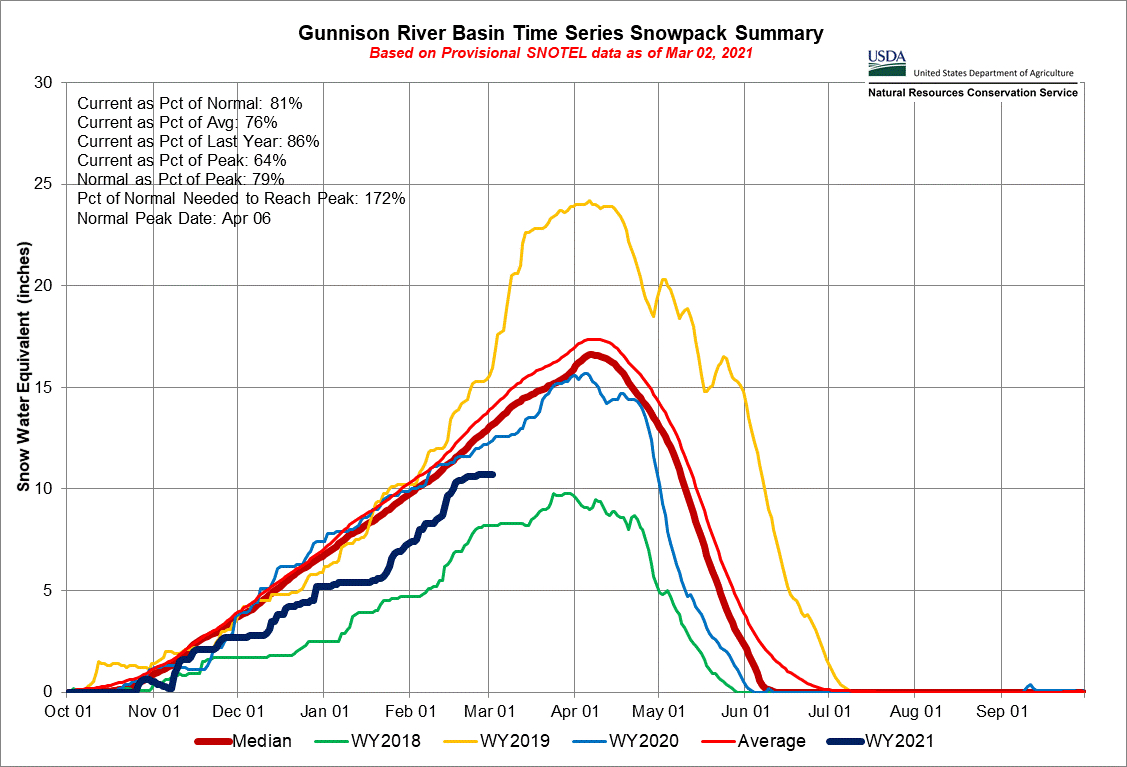
The growth of our snowpack has flatlined and the sandbox is trying to make a resurgence. For the flatline, take a look at the Gunnison River Snowpack Summary. You'll notice that the snowpack stopped growing after about February 16th. This flatline has allowed the avalanche danger to drop over the last couple of weeks and for the sensitivity of the persistent slab avalanche problem to become stubborn. The term sandbox comes from the faceting process taking place in the upper snowpack, primarily on the northern half of the compass. The cold overnight temperatures and clear sky is weakening those snow grains. In shallow snowpack areas, we are even seeing the snowpack go back to all weak snow, and/or holding a thinner section of midpack slab. 

Yesterday we received reports of human-triggered sluffs where the snow surface was weak and faceted. Similar avalanches could be triggered today. One small slab avalanche was also human-triggered on Snodgrass Mountain, and this may have been due to a moist snow surface from the strong sun and daytime warming. Wet avalanche concerns are on the increase today with high temperatures a couple of degrees warmer than yesterday. Any loose wet avalanche concerns are expected to be small. However, the larger persistent slab avalanche problem may become slightly more reactive where the snowpack becomes warm and moist. 

Tomorrow's storm currently doesn't look like it will bring enough load to increase the sensitivity of persistent slabs releasing deeply in the snowpack. Any changes that take place are expected to be related to new snow avalanche problems.

Regions covered