

Quick report
This is a reminder that if you are venturing into terrain you're unfamiliar with or haven't been to recently it's prudent to take a look at the snowpack structure before committing to avalanche terrain. Because we were aware of the likely reactivity in our snowpack test, our group had not committed to skiing the run based on our test results. Rather we were gathering information to track the observed trends, which is also a great learning opportunity.
Although we didn't get any direct feedback regarding shooting cracks or collapsing (Red Flags) we feel confident the possibility of triggering an avalanche on this weak layer is far too great to make sloppy decisions. There have been other natural and human-triggered avalanches in the past two weeks, some that we don't know the weak layer involved and some we do. The fact that we have buried and reactive persistent grains in our snowpack is more relevant.
This is a good time to pump the brakes, take your time, and be diligent in the mountains. We did find lots of fun skiing that was safe!
Weather
- Air Temp
- 28
- Cloud Cover
- scattered
- Wind Loading
- moderate
- Recent Snowfall
- 5
- Snow Avail For Transport
- small smounts
Snowpack
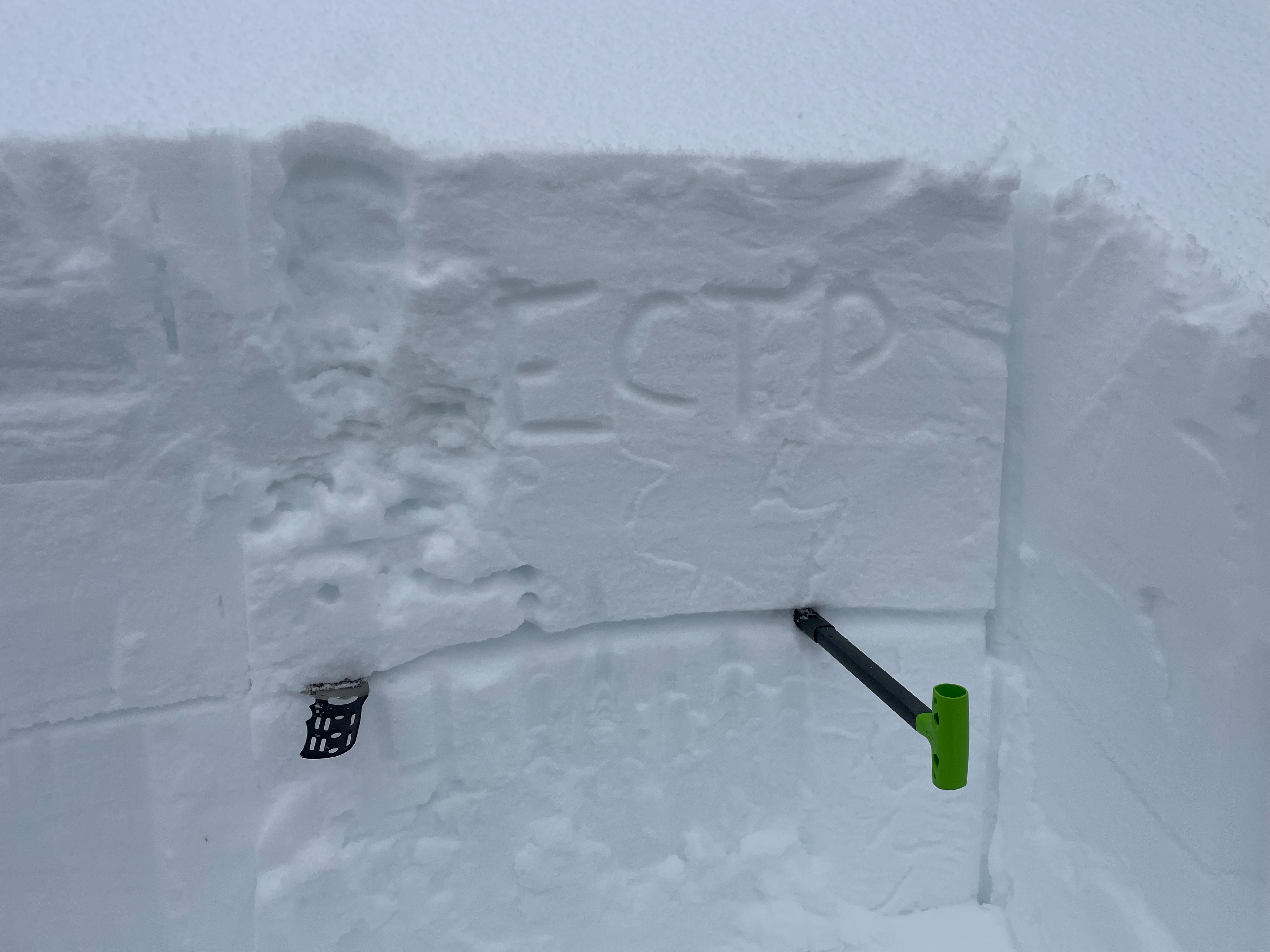
We dug on a North aspect at 7,700' where we knew a layer of reactive surface hoar had been buried 2/26. This is a persistent weak layer that we have been following weekly since it was buried. With the additional weight and slab that now sits on top of this preserved weak layer, it hasn't yet begun healing and is more reactive in our snowpack tests. Although the spatial distribution of this layer is sparse and has only been found in our ski zone on N-NW aspects between 7,300-7,700' it could become problematic at any time. Our group didn't observe any cracking or collapsing, which is more common than we might think for these Persistent Weak Layers.
Our snowpack test revealed unstable results with full propagation on our extended column test.