
Quick report
- Cracking
- Observed
- Collapsing
- Observed
We dug a single profile on a sunny slope and traveled over a few others below 11,000 feet and found less concern for human-triggered avalanches but heavily drifted features could pose a threat if recent winds drifted a slab above soft crusts in the upper snowpack.
The 2/2 interface remains a problem for human-triggering on the north half of the compass. Even in sheltered areas, there is enough slab cohesion for dangerous avalanches. Collapses were often muffled but occurred a handful of times. Conservative slope angles remain the best form of management in the Southeast Mountains for the Persistent Slab problem.
We experienced a handful of muffled collapses without cracking on northerly aspects near and below treeline. We remotely triggered a large avalanche from a ridgetop on a northeast - east slopes at 11,000 feet. Avalanche likely failed at the 2/2 interface - we did not investigate the crown due to hangfire but a nearby profile showed surface hoar resting on facets at the 2/2 interface.Weather
- Wind Loading
- light
Strong winds in the late morning and early afternoon eased around 2pm. Even though nearby southwesterly slopes were crusty, the wind found places to grab snow and deposit onto leeward easterly aspects. Loading was generally light, but produced cracking a few inches deep.
Snowpack
Below treeline, the 2/2 surface hoar/facet layer is buried around 16 inches deep, producing muffled collapses. Snowpack test produced an ECTP 16 at 2/2 interface. Basal depth hoar below the January slab didn't produce results but remains much softer than the overlaying slab. We did not dig near treeline but produced a remotely triggered avalanche on an east-northeast terrain feature at the 2/2 interface which reinforces the sensitive nature of this interface.
Above treeline we dug on an east slope at 12,000 feet and found the 2/2 interface comprised of surface hoar and a thin. soft crust. Snowpack test produced hard results below a thicker, drifted slab. I removed the slab above the 2/2 interface and was able to produce a propagating result in basal depth hoar in a non-standardized test.
Of note, on northerly aspects, a thin layer of facets separates each stormy period since 2/2. The upper facet layers produced ECTN's but may be responsible for some of the natural avalanche activity on recently drifted slopes that appeared to be too shallow for the 2/2 interface.
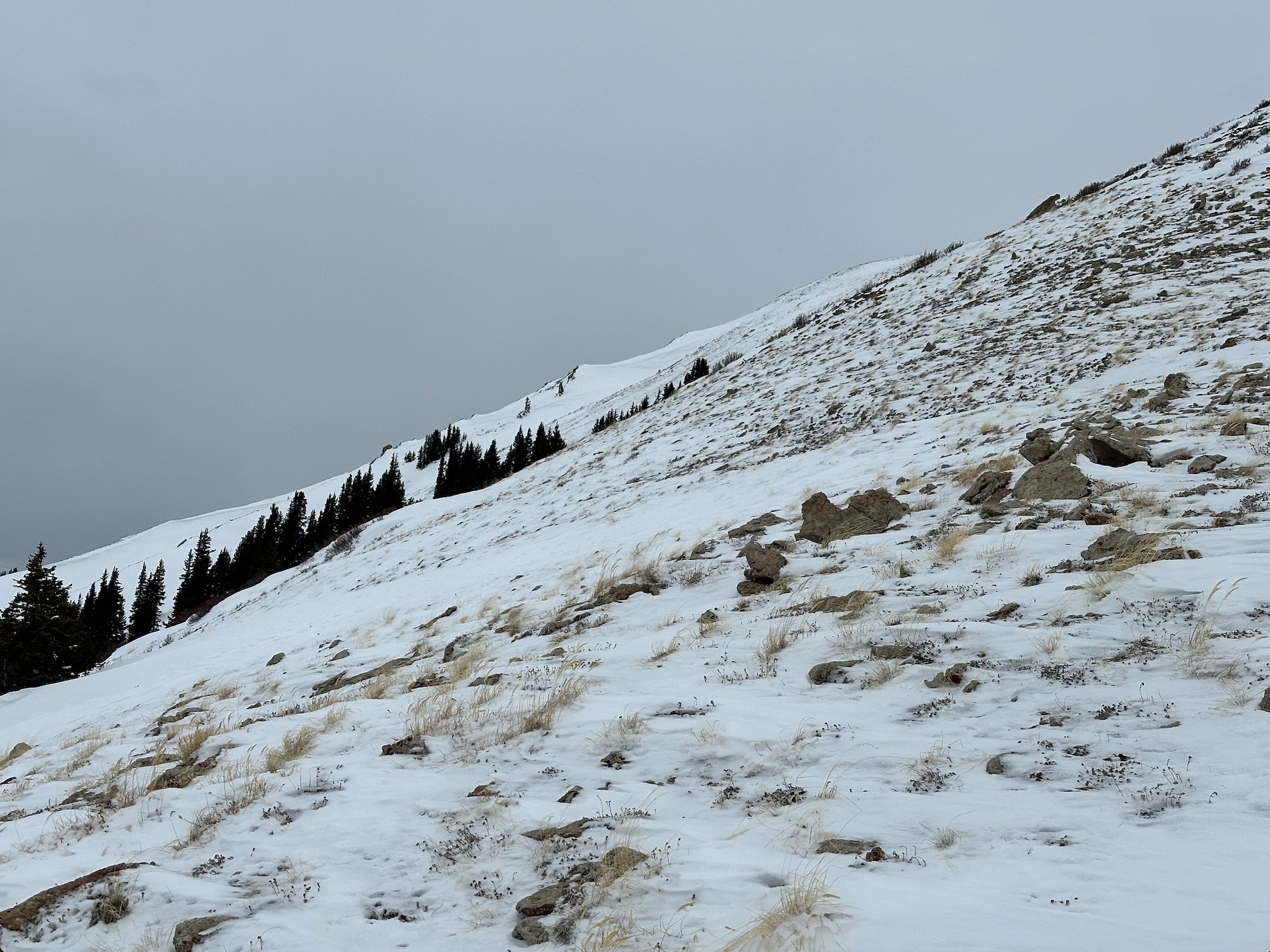
We dug a single profile on a southeast slope near treeline without prior drifting and found little current avalanche concern. The 2/2 melt freeze crust was quite thick with ice columns below but short of reaching the ground. The upper snowpack was crusted with thin, soft, and faceted slabs in between. It would be hard to rule out a triggered avalanche on a heavily drifted sunny slope at upper elevations, however, we did not examine one on this tour.
Avalanche
- Size
- D2 R2
- Type
- SS
- Aspect
- E
- Trigger
- AS
- Elevation
- 11000 ft
Avalanche broke on east through northeast terrain. It appeared to break just below the most wind-loaded part of the slope given a nearby sheltered profile. Size appeared to be a small D2.