
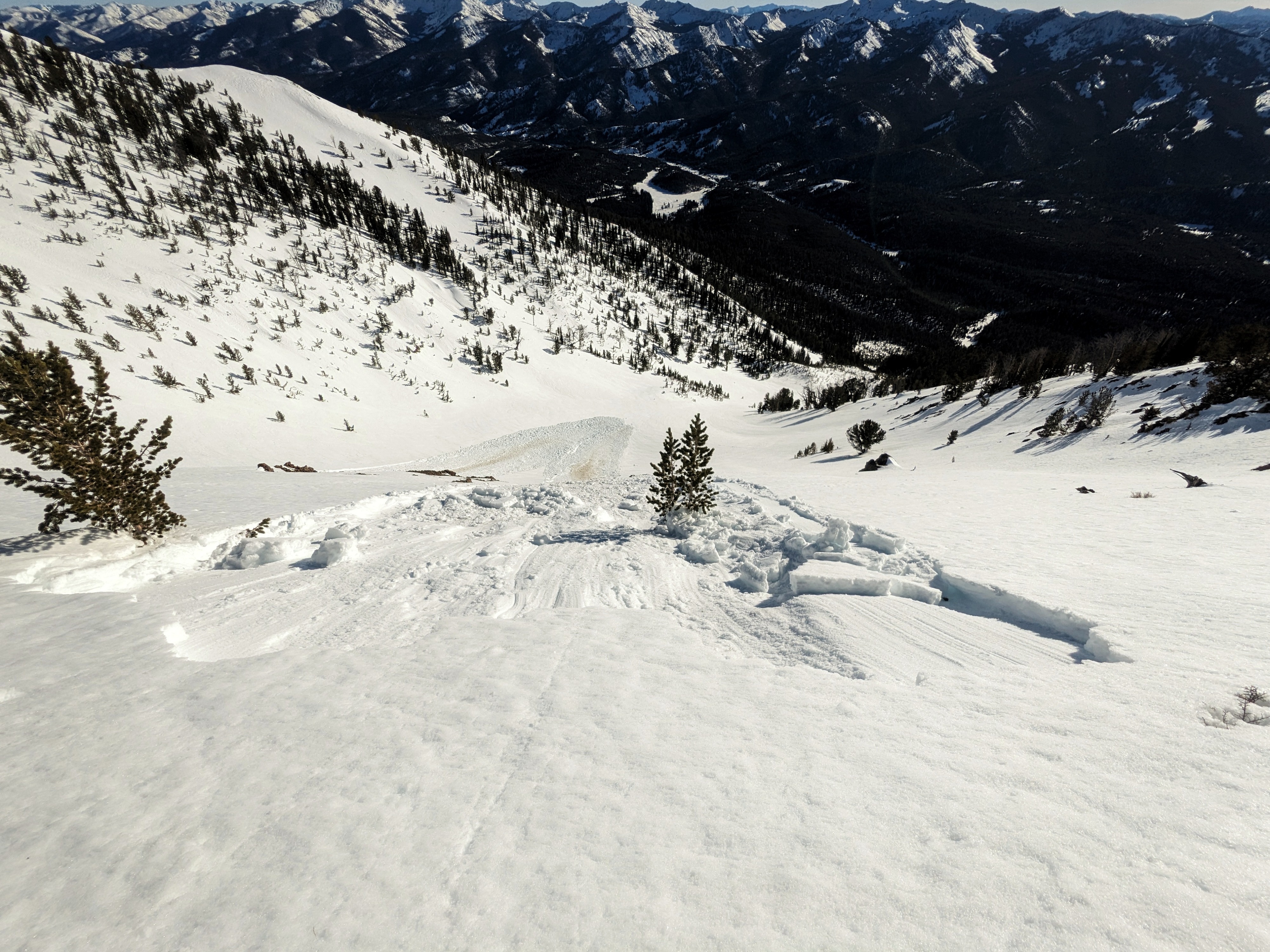
Quick report
- Cracking
- specific
- Collapsing
- specific
This was an off duty afternoon tour to look at extent of wet snow problem and to watch the sunset.
I experienced about 10 collapses on solar slopes at middle elevations. Many were small-ish, but 3 extended into starting zone sized pieces of terrain. These collapses had a wet character to them, I could hear the air being pushed back liquid water in the interstices between snow grains.Weather
- Cloud Cover
- clear
Started tour at 1430, car thermometer read 50F. Intermittent light winds at highway and along the ascent helped to keep things slightly cooler than they would've been otherwise.
Snowpack
I moved through a lot of wet snow today. On many slopes that tipped up towards the sun, I found an unsupportable pile of mush. Crusts were still present and sensible in the snowpack, they just weren't supporting my weight. In colder, more winded terrain, I was able to float on top of the snowpack more easily, but was still able to readily push my pole (basket-first) through the mush.
I easily triggered large avalanches today. Most were initiated as wet loose avalanches, but I was able to remotely trigger one small wet slab as well. Above Gladiator Creek, I experienced large collapses in a wet snowpack that produced cracks that opened up several inches wide. I have little doubt that a person would have made large avalanches in most steep terrain facing the sun this afternoon.
Despite the very easy human triggering, natural activity has not been widespread. We are clearly producing large amounts of meltwater at the snow surface and pushing it into the snowpack. So far, it seems to be "taking it". Going into this warming, we already had drainage channels established in the snowpack below the 2/1 interface. We have generated drainage channels in the upper snowpack over the past few days. Long story short, we are pushing plenty of water into the pack and lubricating lots of weak layers...there is a lot of uncertainty around wet slab avalanche activity, but I'll be traveling with these beasts in mind until we get a cold days to drain and refreeze the snowpack.
I dug at 8500' on a SSW slope after I collapsed the slope:
HS=75-85
Well lubricated weak layer down 40cm cleanly shearing in my pit. This layer did not produce propagating fractures in ECTs (likely because the slab was so degraded by water), but I was able to initiate fractures by doing CPSTs on a deeper weak layer, which collapsed the column, which would then initiate a propagating fracture.
Avalanche
- Size
- D2
- Type
- WL
- Count
- 5
- Aspect
- SW
- Trigger
- AS
- Elevation
- 10000 ft
I easily triggered these three D2 wet loose avalanches with a ski cut. These slides gouged to near the ground and entrained lots of debris.