
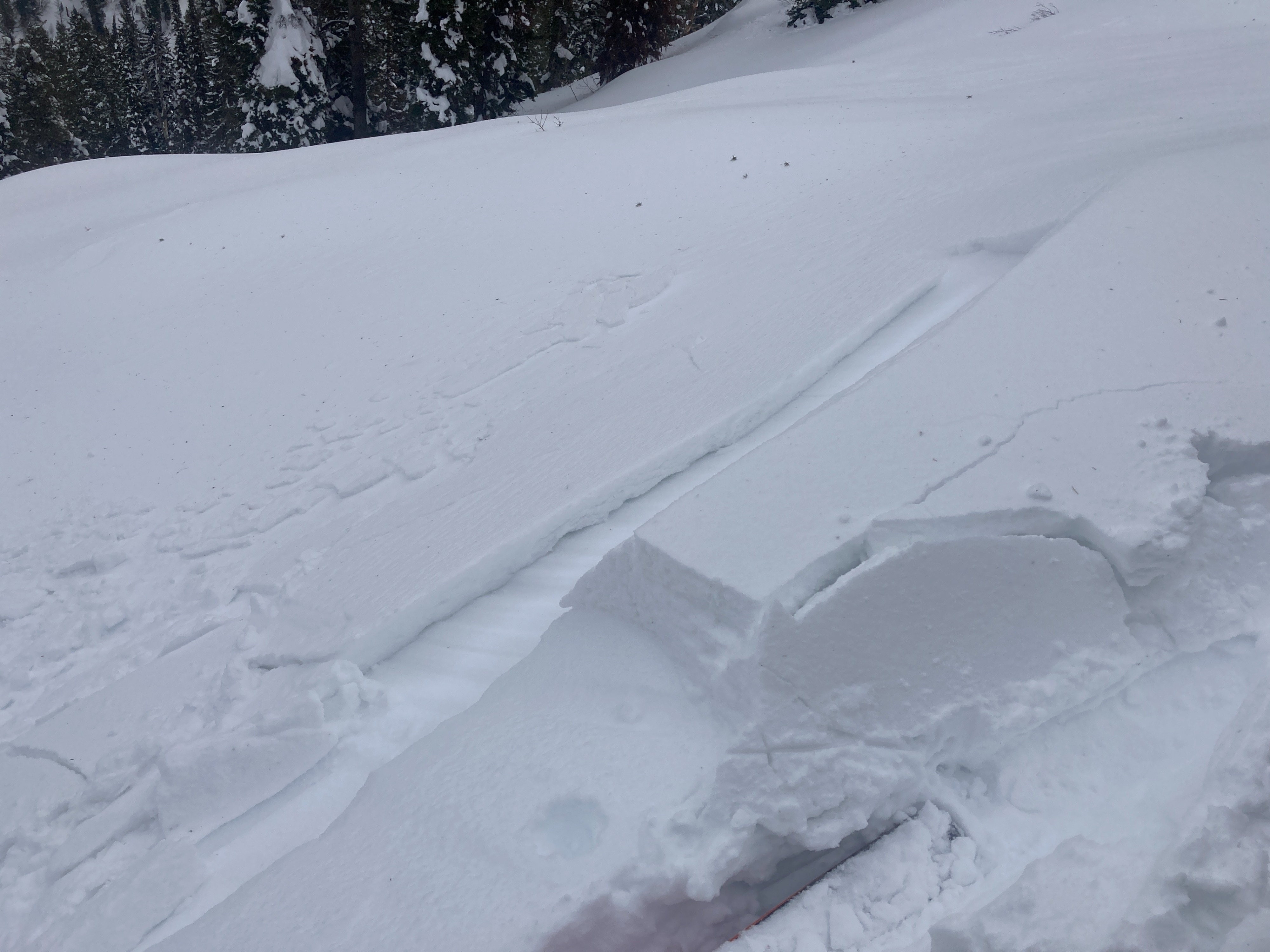
Quick report
- Cracking
- isolated
Toured up to 8,000’ in southeast through northeast facing terrain. We did not observe any significant recent avalanche activity. Visibility was decent for the first half of the day. Winds out of the west were transporting snow above 7,000’. We found several small, yet reactive pockets of newly formed wind slab (~4”) deep on the leeward side of the ridge. Moderate snowfall (S2) started at 12:30pm. A 2-3cm thick melt freeze crust exists on the surface up to 6,500’ and up to 8,000’ on south aspects.
Cracking was isloated to small wind loaded pockets along the ridgeline.Weather
- Air Temp
- 27
- Cloud Cover
- overcast
- Wind Loading
- light
- Recent Snowfall
- 0
- Snow Avail For Transport
- small smounts
Snowpack
Dug two pits about 1,000 vertical feet apart from each other. The general structure is similar with a cohesive slab of snow from the February storms sitting on top of a rain crust from the first few days of February. The strength of the old snow below the crusts varied significantly. Well developed facets and propagating test results were observed in the lower pit and not in the higher pit.
Pit 1: East facing slope at 6,700’. Poor structure, moderate strength, propagation (ECTP16). Here, 70 cm (27”) of 4F snow from the February storms sits on top of a rain crust with facets below.
Pit 2: ENE facing slope at 7,700’. Moderate structure, high strength, no propagation (ECTX). Here, 100cm (3.3 ft) of 4F-1F snow is sitting above the rain crust. I did not find any facets above or between the crusts.