
Quick report
- Slope Angle
- 37°
Avalanche
- Slab Width
- 61 m
- Weak Layer
- New Snow
- Trigger Type
- Skier
- Vertical Fall
- 91 m
- Avalanche Type
- Soft Slab
- Slab Thickness
- 18 cm
- Trigger Detail
- Cornice Triggered
- Start Zone Aspect
- Northeast
- Avalanche Problem
- Wind Slab
- Start Zone Elevation
- 2835 m
Easy clean shears under 6-inches of new high-density new snow in shovel tilt tests hinted at the possibility of connected soft-slab avalanches in steep terrain. Walking the Reynolds shoulder from Lee's Fork, we kicked a small cornice onto the wind loaded north-facing slope and got 50 foot cracks in the new snow, failing down 6-8 inches. The plate of snow moved only 4 inches downhill. Another 10 steps up the ridge we loosed a second small piece of snow and this time triggered the whole upper bowl of Reynolds, propagating roughly 200 feet to where the slope is east-facing. The wide but shallow slide hit the bench at 9,000 feet.
Photos:
1) Crack with no slide
2) Better luck!
3) Closer view of the shallow crown
4) Looking down at the debris where it just reaches the bench
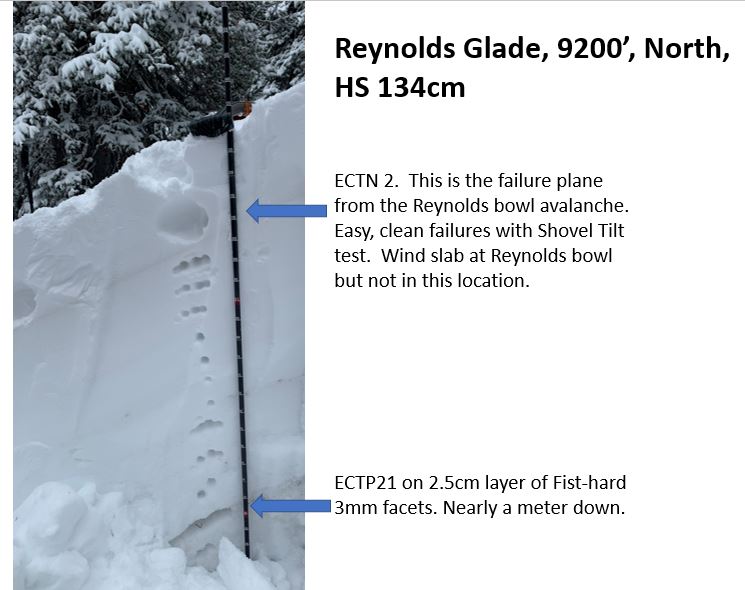
The new-snow avalanche did not step down into the weak snow at the base. However, propagation on the basal layer occurred in our north-facing test pit at 9200 feet. On the 21st tap (1st hit from the shoulder) the block failed 1 meter down on a thin layer of 3mm facets. Even a low elevation (7,600 foot) north facing pit with HS 30cm showed propagation on damp basal facets. Likely elsewhere in the range this recent storm did indeed tip the balance, and result in deep persistant weak layer avalanches. With continued accumulation in the next several days, even some low elevation slopes might avalanche. A quick north facing pit at 7,600 feet with HS 30cm showed propagation on damp basal facets.
Wind was moderate to strong from the southwest, easily transporting snow across Reynolds ridge and loading the lee.