Lawinenlagebericht

Northwest Mountains

Crested Butte Avalanche Center
Auf der Karte ansehen

Lawinengefahr

Sun
Hochgebirge
2 · Mässig
Waldgrenze
2 · Mässig
Unterhalb
2 · Mässig
Veraltet — dieser Lagebericht ist 3 years ago abgelaufen. Du siehst vergangene Verhältnisse, nicht den aktuellen Bericht.

Kernpunkte

Skiers and riders have been finding the safest riding and best powder where the snowpack is deep and protected from the sun and wind on northerly aspects.   This week, several large natural and triggered avalanches have occurred in wind-drifted terrain or as you move towards sunnier terrain (east or west facing) where there are several recently buried problematic crusts.  Stay cautious of sunbaked slopes once surface crusts thaw.  This video summarizes most of the dangerous avalanche activity we saw this week.    

Lawinenprobleme

  • Persistent Slabs

    • Hochgebirge
    • Waldgrenze
    • Unterhalb der Waldgrenze
    Wahrscheinlichkeit
    Possible
    Größe
    2–3

    There are several faceted crusts in the upper few feet of the snowpack that have produced avalanche activity this week.  The uppermost layer is buried about a foot deep on easterly and westerly aspects.  The deeper layer is buried up to 3 feet deep and is most concerning in wind-protected terrain at mid and lower elevations on the same aspects.  Carefully assess the snowpack structure and give yourself a margin for error in handling this problem.  You can reduce your risk by traveling on aspects where the problem hasn't been as active.  Choose mellower slope angles when in doubt.  


    A persistent slab in the Anthracites ran midweek.   

  • Storm Slabs

    • Hochgebirge
    • Waldgrenze
    • Unterhalb der Waldgrenze
    Wahrscheinlichkeit
    Possible
    Größe
    1–2

    Our midweek storm formed storm slabs more than a foot thick on drifted terrain.  The threat of new snow instabilities is diminishing now that we are three days from the storm.  The most concerning slopes are at higher elevations where drifting caused slabs to be thicker and denser, or on very steep rollovers below treeline.  Additionally, watch for shallow sluffs on shady aspects and loose wet avalanches to develop on the southern half of the compass once surface crusts thaw into mushy snow.  

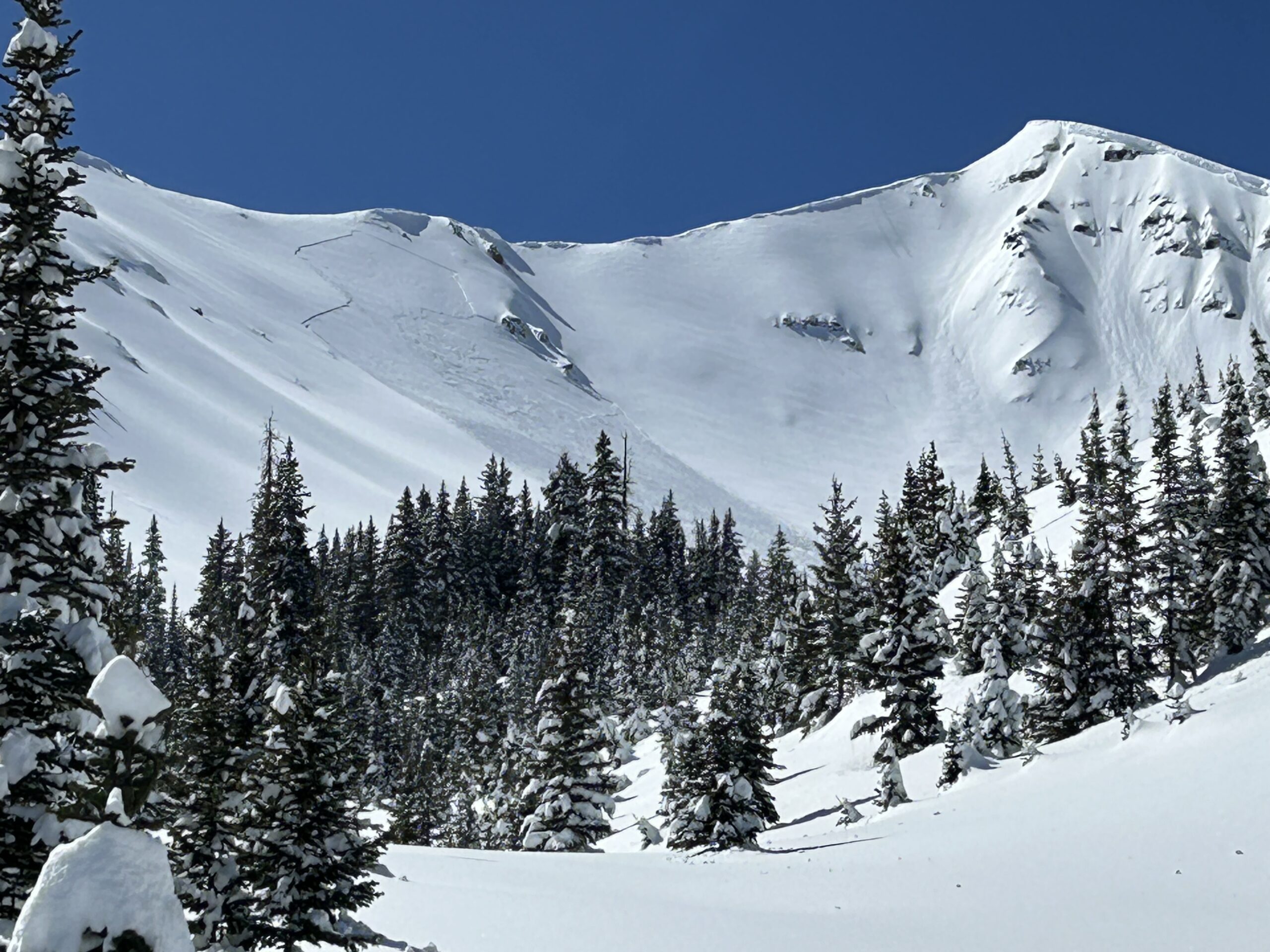
    A large storm slab in Wolverine Basin in terrain where winds stiffened the recent storm snow.  

Avalanche Discussion

The oscillating pattern of large winter storms and subsequent warmups have created challenging avalanche conditions, and backcountry traveleris continue to get surprised.  Another large slab was triggered yesterday on Mt. Justice on an easterly aspect.  The eastern quadrant has been the bullseye for large avalanches this week.  There are several buried crusts in the upper snowpack that are giving irregular but dangerous feedback, including these D2.5 and D3 avalanches near Marble, this D2.5 avalanche in the Anthracites, and this D2 on Mt. Axtell.  Our March 10th interface, at the base of our two big storms a few feet deep, has been most productive in shallow areas, demonstrated in this video, or wind-protected/leeward slopes where thin faceted crusts developed during our early March dry spell, described in this video.  Our forecast team has been looking for the same issue on northerly aspects lacking a crust without success, although I suspect you could find the issue on an unusually shallow or rocky slope, particularly along the southern boundary of our forecast area.  The most recent facet/crust layer (3/15) is buried about a foot deep on the same aspects, and evolving from a storm slab issue to a persistent slab issue. We believe this issue spans all elevations because it formed during a period without much wind damage. Thus, I'm expanding the rose today to account for the issue persisting into the next round of storms as this week's storm slabs phase off the list, potentially by tomorrow. 

Issues on the southern half of the compass will be driven by surface warming today.  While crusts are frozen this morning, you have a lower likelihood of triggering a slab and no concerns for wet loose activity.  Once the snow surface becomes soft and mushy, instabilities will be more likely.  Time your travels into steep terrain accordingly.  

In summary, there seem to be more issues on sun-warmed slopes due to buried crusts and warming-related slab consolidation or wet activity.  The powder is higher quality on the coldest aspects and has been less active except for in drifted terrain, like this slide in Wolverine Basin.  

Events:  The Al Johnson race is Sunday, March 19. Information and registration are here.  Day of race registration and bib pick up 9-11 a.m. at the Adventure Center in Mountaineer Square. Proceeds go to the CBAC.

Abgedeckte Regionen